Contact us
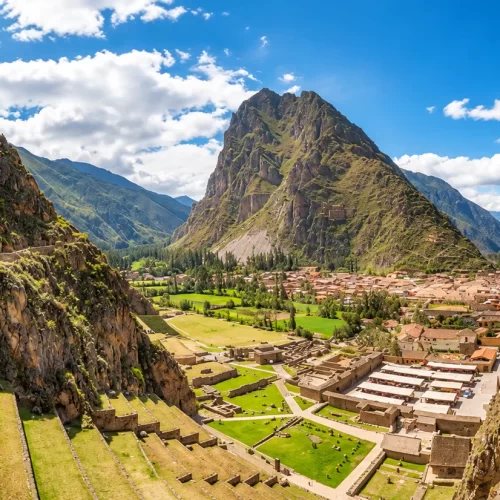
Cradled at the western confluence of the Patakancha and Urubamba rivers, where the fertile plains of the Sacred Valley narrow into a dramatic granite canyon descending toward the Amazonian cloud forests, lies one of the most extraordinary settlements in the Americas: Ollantaytambo. While visitors across the globe marvel at Machu Picchu as a romantic, deserted citadel of stone, Ollantaytambo offers something far rarer: an authentic Living Inca Town (Pueblo Inca Viviente) that has remained continuously inhabited, without interruption, for more than five hundred years.
Walking the narrow cobblestone alleys of its ancient residential blocks (canchas), you trace the exact urban grid engineered in the mid-fifteenth century by the great Inca Emperor Pachacuti. Crystalline mountain water still murmurs through carved stone aqueducts flanking the streets; families step through original trapezoidal stone portals into flower-filled courtyards; and towering directly above the village, the monumental Sun Temple Fortress climbs the mountainside in an awe-inspiring staircase of agricultural terraces crowned by the colossal, fifty-ton megaliths of the Wall of the Six Monoliths.
At Peruvian Luxe, we transform a visit to Ollantaytambo from a rushed transit stop en route to the train into a deeply enriching luxury immersion. From private guided walks with specialist archaeologists through hidden corners of the fortress to ancestral Pachamanca earth-oven banquets prepared on organic farms, and seamless connections to the luxury Belmond Hiram Bingham train, we unlock the soul of the Inca Empire’s ultimate living sanctuary.
Planning your journey through the Sacred Valley? Connect with Peruvian Luxe on WhatsApp to arrange your bespoke private Ollantaytambo itinerary.
The Living Inca Town (Pueblo Inca Viviente): Urban Genius Frozen in Time
Most archaeological sites across the Mediterranean, Mesoamerica, or Egypt are ruins—monuments preserved in museums or isolated behind protective ropes. Ollantaytambo is an astonishing exception. It is the only surviving urban town where the original 15th-century Inca civic street plan continues to function as the daily home of an indigenous community.
The Architecture of the Canchas
Commissioned by Pachacuti following his conquest of the valley around 1440 AD, Ollantaytambo was designed as an elite royal estate, religious sanctuary, and military bastion. The southern sector of the town, known as Arakama Ayllu, is organized into four longitudinal streets crossed by seven transverse streets, creating a flawless grid of rectangular walled compounds known as canchas.
- Trapezoidal Portals: Each residential compound is entered through an imposing double-jamb trapezoidal doorway carved from volcanic andesite, designed to distribute seismic loads and withstand major earthquakes.
- Living Water Channels: Along the edge of every cobblestone lane runs a sunken stone canal delivering pure glacial meltwater diverted from the Patakancha River. For half a millennium, this ingenious hydraulic system has cooled the town, watered private courtyards, and supplied households.
- Communal Patios: Within each cancha, individual stone homes open onto a central open-air patio, preserving the ancestral communal family structure (ayllu) that formed the bedrock of Inca society.
The Magic Hour: Visiting After 5:00 PM
The vast majority of day-tour buses from Cusco arrive in Ollantaytambo between 11:00 AM and 2:00 PM, inundating the main square before rushing travelers toward the train station. However, when the sun dips below the mountain crests around 5:00 PM and the day-trippers vanish, Ollantaytambo undergoes a profound transformation.
The cobblestone alleys fall into reverent silence, broken only by the rush of water in the aqueducts and the soft footsteps of local Quechua women in red embroidered pollera skirts. Soft amber street lanterns illuminate ancient stone walls, revealing the texture of centuries-old chisel marks. An evening stroll through the lanes of Calle Chaupi Calle or Calle Laris is one of the most transporting historical experiences in South America.
The Sun Temple Fortress: Megalithic Mastery & Military Triumph
Rising like a colossal stone pyramid above the western edge of the town plaza, the archaeological complex of Ollantaytambo—frequently referred to as the Fortress (La Fortaleza) or the Royal Hall (Real Alcázar)—is one of the supreme masterpieces of pre-Columbian civil and military engineering.
The Terraced Ascent
Visitors begin their exploration at the foot of seventeen massive agricultural terraces (andenes). Constructed with dressed fieldstone retaining walls rising up to four meters high, these terraces were not built merely for crops; they were defensive ramparts engineered to restrict enemy movement and stabilize the steep mountain slope against landslides. Climbing the more than two hundred stone steps is an exhilarating physical ascent that offers increasingly panoramic views over the terracotta roofs of the town below.
The Epic Battle of Ollantaytambo (1537)
It was on these very terraces that the Incas achieved one of their greatest military victories against the Spanish conquistadors. In January 1537, the rebel Emperor Manco Inca retreated to Ollantaytambo following his siege of Cusco, establishing his headquarters upon the upper terraces.
When Hernando Pizarro led a force of Spanish cavalry, infantry, and thousands of indigenous allies to storm the fortress, Manco Inca’s warriors rained down boulders, javelins, and arrows from the high terraces. In a stroke of tactical genius, Manco Inca opened the sluice gates of his upper canals, flooding the flat valley floor below. Trapped in knee-deep mud, the Spanish cavalry became useless, forcing Pizarro to sound a panicked retreat back toward Cusco. It was a legendary demonstration of how Inca architecture and hydraulic engineering were weaponized to defend imperial sovereignty.
The Wall of the Six Monoliths: A Megalithic Enigma
At the apex of the complex sits the unfinished Temple of the Sun, dominated by the legendary Wall of the Six Monoliths (Muro de los Seis Monolitos). Composed of six colossal, rectangular slabs of red porphyry granite standing nearly four meters tall and weighing up to fifty tons each, this structure represents the pinnacle of Inca stonework.
Key architectural marvels of the monoliths include:
- Spacer Stones: Between each monumental slab, Inca masons inserted thin vertical filler stones fitted with such surgical accuracy that a razor blade cannot be slipped into the joints.
- Relief Carvings: On the front face of the fourth monolith, faint stepped motifs representing the sacred Chakana (Andean Southern Cross) remain visible, catching the oblique rays of the rising winter solstice sun.
- The Kachiqhata Quarry Feat: The red granite used for these monoliths does not exist on this side of the mountain. It was quarried at Kachiqhata (Cachiccata), located more than four miles away on the opposite side of the roaring Urubamba River. Inca engineers cut these fifty-ton blocks using bronze chisels and stone hammers, slid them down steep gravel ramps, diverted the river to haul them across dry riverbeds, and pushed them up a massive earthen ramp to the fortress summit—all without the wheel, draft animals, or iron tools.
The Princess’s Bath (Baño de la Ñusta)
Descending into the lower religious sector brings you to the sacred water shrines. Here, the Baño de la Ñusta (Bath of the Princess) features an exquisitely sculpted block of gray andesite where water cascades in a continuous, crystal-clear sheet into an underground stone basin. Andean shamans and archaeologists believe this was a ceremonial ablution chamber dedicated to Mama Cocha, the goddess of waters.
Pinkuylluna & Tunupa: The Guardian Mountain Across the Valley
Directly opposite the Sun Temple, on the sheer vertical cliffs of Mount Pinkuylluna, stands a collection of mysterious, multi-story stone structures that look as if they are defying gravity. These are the imperial qollqas (Inca agricultural storehouses).
Thermodynamic Engineering in the Sky
The placement of these storehouses was a stroke of meteorological genius. Because the Inca economy relied on centralized redistribution, vast reserves of maize, dried potatoes (chuño), and llama jerky (charqui) had to be preserved for years in case of famine or military mobilization.
Inca builders placed these storehouses high up on the eastern cliffs of Pinkuylluna to harness the powerful, cool thermal drafts that funnel through the canyon every afternoon. The buildings were fitted with narrow, cross-ventilating lattice windows and raised slatted floors, creating a natural refrigeration system that kept humidity low, prevented mold, and preserved food stocks for decades.
The Face of Tunupa (Viracocha)
When standing at the base of the Sun Temple and looking across at Pinkuylluna in late afternoon, look carefully at the natural rock formations flanking the storehouses. You will discern the striking profile of a colossal face carved by wind, shadow, and human hand: the Face of Tunupa (also identified with the supreme creator god Viracocha).
The profile features a prominent brow, an aquiline nose, a flowing beard, and a ceremonial headpiece formed by the stone storehouses above. To the Inca, this natural mountain formation was a sacred huaca, proof that the divine creator was perpetually watching over the royal estate.
The Pinkuylluna Ridge Hike
For active travelers seeking solitude away from crowds, the trail to Pinkuylluna begins discreetly from a small cobblestone alley near the town market. A steep, unpaved 30-to-40-minute hike brings you directly into the ancient storehouses, offering what many photographers consider the single finest aerial view looking across the valley at the entire terraced sweep of the Sun Temple Fortress.
Haute Epicurean Tradition: Farm-to-Table & The Ancestral Pachamanca
A luxury journey to Ollantaytambo is incomplete without engaging with the Sacred Valley’s deep gastronomic roots. The valley’s mineral-rich alluvial soil and pure mountain runoff produce some of South America’s most celebrated produce—including giant white Urubamba corn (choclo), heirloom potatoes, and wild native herbs.
The Iconic El Albergue Experience (Est. 1925)
Located directly beside the historic train station platform, El Albergue Ollantaytambo is an intimate, legendary heritage property that has welcomed discerning travelers, artists, and explorers for a century. Surrounded by lush eucalyptus trees and organic gardens, El Albergue is celebrated for pioneering sustainable, farm-to-table Andean luxury.
The Traditional Pachamanca Feast
The pinnacle of culinary immersion in Ollantaytambo is experiencing an authentic Pachamanca—an ancestral Quechua earth-oven banquet that dates back millennia:
- The Ritual Preparation: Volcanic granite river stones are heated over a roaring wood fire fueled by aromatic eucalyptus and native wood. Meanwhile, an underground pit is prepared in the soil of the hotel’s organic farm.
- The Layering: Once the volcanic stones are white-hot, they are carefully transferred into the pit. Meats (marinated chicken, tender lamb, and pork seasoned with huacatay, the wild Andean black mint) are placed directly upon the stones. Subsequent layers of native potatoes, sweet camote, broad beans (habas), and plantains are layered above, separated by damp banana leaves and natural burlap sacks.
- The Burial & Blessing: The pit is sealed completely with clean earth, trapping the intense geothermal heat and aromatic steam. A traditional floral cross is placed atop the mound as a reverence to Pachamama (Mother Earth).
- The Unearthing & Banquet: Forty-five minutes later, the earth is ceremoniously uncovered. Guests dine al fresco under covered pergolas overlooking the organic fields and the ruins of Pinkuylluna, enjoying succulent, earth-roasted meats paired with fresh organic farm salads, artisanal ají sauces, and chilled Peruvian wines.
Artisanal Spirits: Destilería Andina & Matacuy
Adjoining the organic farm is Destilería Andina, an acclaimed craft micro-distillery. Here, master distillers craft Matacuy, a legendary Andean botanical elixir distilled from sugar cane and macerated with twelve wild medicinal herbs gathered by hand from high-mountain slopes. Savoring an artisanal Matacuy digestif or a single-origin coffee roasted on-site is the definitive conclusion to an Ollantaytambo afternoon.
The Strategic Gateway: Train Logistics & Altitude Acclimatization
Ollantaytambo occupies an indispensable strategic role on any luxury Peru itinerary, both logistically and physiologically.
The Altitude Advantage: Why You Should Sleep in the Sacred Valley
One of the most critical health advantages of Ollantaytambo is its elevation. Sitting at 2,792 meters (9,160 feet), it is more than 600 meters lower than Cusco (3,400m). For newly arrived international travelers, heading directly from the airport in Cusco down to a luxury resort in the Sacred Valley or Ollantaytambo dramatically accelerates your physiological adaptation, virtually eliminating the risk of debilitating acute mountain sickness.
The Luxury Train Gateway to Machu Picchu
Ollantaytambo’s train station is the primary embarkation point for rail journeys into the cloud forests of Machu Picchu. From here, you can board South America’s most glamorous train services:
- The Belmond Hiram Bingham: The pinnacle of vintage 1920s luxury rail travel, featuring polished wood, brass accents, fine dining gourmet brunch, free-flowing cocktails, and an open-air observation car with live Andean folk music.
- Inca Rail First Class & The 360°: Contemporary panoramic cars offering gourmet tasting menus, live music, and panoramic domed glass ceilings framing granite peaks.
- PeruRail Vistadome Observatory: Panoramic observation lounges featuring folkloric dance performances and sweeping skylights.
Peruvian Luxe ensures seamless private coordination: your chauffeur whisks your luggage directly to the train porter, while your private guide escorts you to your reserved club-car seats, ensuring complete ease.
Comparative Overview: Key Archaeological & Cultural Sectors
The following table outlines the distinct sectors of Ollantaytambo to help you optimize your exploration time:
| Sector Name | Historical Identity | Signature Architectural Feature | Physical Demand | Ideal Visiting Time |
|---|---|---|---|---|
| The Sun Temple (Fortaleza) | Royal ceremonial sanctuary and military stronghold of Manco Inca | The Wall of the Six Monoliths (50-ton red granite slabs) | Moderate (200+ stone terrace steps) | 08:00 AM – 10:00 AM (Soft morning light before tour buses) |
| Living Inca Town (Arakama Ayllu) | Continuously inhabited 15th-century royal residential grid | Original stone canchas, trapezoidal doorways, running canals | Easy (Flat cobblestone stroll) | 05:00 PM – 07:00 PM (Tranquil evening golden hour) |
| Pinkuylluna Storehouses | Imperial food storage granaries (qollqas) and sacred mountain shrine | Thermodynamic stone silos & the Face of Tunupa profile | Challenging (Steep unpaved 40-minute ridge climb) | 03:30 PM – 05:00 PM (Late afternoon light across the canyon) |
| Baño de la Ñusta & Water Sector | Ceremonial purification fountains dedicated to water deities | Carved andesite fountain with unbroken cascading water sheet | Easy (Located at the base of the fortress) | Midday or late afternoon |
| El Albergue Organic Farm | Century-old agricultural estate, bio-farm, and craft distillery | Traditional Pachamanca earth ovens and Destilería Andina | Relaxed (Garden walkways) | 12:30 PM – 02:30 PM (Private gourmet lunch feast) |
Curated Luxury Itineraries & Premier Accommodations
Where to Stay: Premier Sacred Valley Lodges
While Ollantaytambo is home to charming boutique properties like El Albergue, many luxury travelers prefer basing themselves at world-renowned five-star resorts located within a 15-to-25-minute private drive along the valley:
- Tambo del Inka, a Luxury Collection Resort & Spa (Urubamba): Featuring its own private train platform to Machu Picchu, magnificent thermal indoor/outdoor swimming pools, and an award-winning Andean spa.
- Belmond Hotel Río Sagrado (Urubamba): Intimate riverside stone casitas set amid lush gardens where guests can feed baby alpacas beside the rushing Urubamba River.
- Sol y Luna (Relais & Châteaux, Urubamba): Private round adobe casitas decorated with museum-grade folk art, private plunge pools, and exquisite culinary dining.
- Inkaterra Hacienda Urubamba: Panoramic hillside suites overlooking the cornfields, offering sublime mountain tranquility.
A Curated 1-Day Ollantaytambo Immersion
- 08:30 AM – Private Chauffeur Arrival: Depart your Sacred Valley luxury resort in a private SUV, arriving at Ollantaytambo before the commercial tour bus rush.
- 09:00 AM – Private Archaeologist Tour of the Fortress: Ascend the terraces, inspect the Wall of the Six Monoliths, and uncover the tactical secrets of the Battle of 1537.
- 11:30 AM – The Living Inca Town Walk: Stroll through the cobblestone canchas of Arakama Ayllu, visiting an active family home to see guinea pig hearths and traditional weaving.
- 12:30 PM – Private Pachamanca Feast: Savor a private earth-oven lunch and craft Matacuy tasting on the organic grounds of El Albergue.
- 03:30 PM – Board the Hiram Bingham or Return to Resort: Board your luxury afternoon train to Aguas Calientes, or return to your resort spa for an evening hot-stone massage.
To deepen your Sacred Valley exploration, explore our guides to the Pisac ruins and artisan market and our curated recommendations for the finest luxury lodges in the Sacred Valley.
Frequently Asked Questions About Visiting Ollantaytambo
Why is Ollantaytambo called the 'Living Inca Town'?
Ollantaytambo is known as the ‘Living Inca Town’ (Pueblo Inca Viviente) because it is the only town in Peru that has been continuously inhabited since the 15th century while preserving its original Inca urban plan. The grid of narrow cobblestone streets, trapezoidal stone doorways, residential walled compounds (canchas), and active stone water canals are the exact structures engineered by Emperor Pachacuti around 1440 AD.
How did the Incas transport the 50-ton stones at Ollantaytambo?
The massive red porphyry granite blocks of the Wall of the Six Monoliths were quarried at Kachiqhata (Cachiccata), located over four miles away across the Urubamba River. Inca stonemasons used stone hammers and bronze chisels to shape the blocks, lowered them down steep mountainsides along stone slides, diverted the river flow to haul them across riverbeds on rollers, and hauled them up a massive earthen ramp to the summit using hundreds of laborers and thick ropes, all without draft animals or the wheel.
What ticket do I need to visit the Ollantaytambo ruins?
To enter the main Sun Temple Fortress of Ollantaytambo, you need the official Boleto Turístico del Cusco (Cusco Tourist Ticket). If you are only visiting the Sacred Valley, the Partial Circuit III Ticket (Boleto Turístico Parcial Circuito III) covers Ollantaytambo, Pisac, Moray, and Chinchero over a two-day period. Peruvian Luxe includes all necessary entry tickets in our private touring arrangements.
What was the Battle of Ollantaytambo in 1537?
The Battle of Ollantaytambo took place in January 1537, when rebel Inca Emperor Manco Inca defended the fortress against a Spanish army led by Hernando Pizarro. Manco Inca positioned archers and warriors on the high terraces and brilliantly opened the irrigation canals to flood the valley plain below, bogging down the Spanish cavalry and forcing them into a humiliating retreat. It was one of the few major military victories the Incas achieved against Spanish conquistadors.
What is a Pachamanca lunch, and how can I experience it?
A Pachamanca is an ancestral Andean cooking ritual where marinated meats (chicken, lamb, pork), native tubers (potatoes, sweet potatoes), and vegetables are cooked underground using volcanic river stones heated by wood fires. El Albergue Ollantaytambo offers the premier luxury Pachamanca experience, including an organic farm tour, ceremonial blessing, and outdoor dining overlooking the ruins.
What is the altitude of Ollantaytambo, and is altitude sickness common?
Ollantaytambo sits at an elevation of 2,792 meters (9,160 feet) above sea level, significantly lower than Cusco (3,400 meters). Because of this lower altitude, acute mountain sickness is far less common here, making Ollantaytambo and the surrounding Sacred Valley the ideal location for international travelers to spend their first few days acclimatizing comfortably.
What are the Pinkuylluna ruins opposite the fortress?
Pinkuylluna is a steep mountain located directly across the valley from the main fortress. The stone structures clinging to its cliff faces are imperial Inca qollqas (storehouses) placed high to capture cool canyon winds that naturally refrigerated and preserved stored grain and tubers. On the rock face beside the storehouses, natural erosion forms the dramatic profile of the creator god Tunupa (Viracocha).
How do I get to Machu Picchu from Ollantaytambo?
Ollantaytambo is the main rail terminal connecting the Sacred Valley with Machu Picchu (Aguas Calientes). Trains operated by PeruRail (including the luxury Belmond Hiram Bingham and Vistadome) and Inca Rail (including First Class and 360°) depart multiple times daily, with the scenic train journey taking approximately 1 hour and 30 minutes through the dramatic Urubamba River gorge.
Is it better to visit Ollantaytambo as a day trip or stay overnight?
While many travelers visit Ollantaytambo as a brief daytime stop, spending at least one night in or near Ollantaytambo is strongly recommended. This allows you to experience the fortress in the quiet early morning before day-tour groups arrive, stroll the living Inca town at dusk when it is peaceful and magical, and enjoy a relaxed farm-to-table dinner.
How does Peruvian Luxe arrange a private tour of Ollantaytambo?
Peruvian Luxe arranges completely personalized journeys: private chauffeured luxury SUVs from your Sacred Valley resort, specialist archaeologist guides for private fortress explorations, VIP reservations for the traditional Pachamanca at El Albergue, and seamless luggage coordination and boarding for your onward luxury train to Machu Picchu.
Experience the Living Soul of the Incas with Peruvian Luxe
To walk the stone streets of Ollantaytambo is to realize that the Inca Empire never truly vanished. It lives in the water running through stone channels, in the warm hospitality of Quechua families tending ancient hearths, and in the sheer, triumphant majesty of granite monoliths standing proud against Andean skies.
At Peruvian Luxe, our bespoke Sacred Valley journeys ensure you experience this living wonder with unmatched elegance. From private archaeologist guides who bring ancient battles to life, to private Pachamanca feasts beneath mountain peaks and effortless connections to the Belmond Hiram Bingham, every moment is crafted to perfection.
Begin designing your journey today. Contact Peruvian Luxe on WhatsApp and let us curate your private journey through Ollantaytambo and the Sacred Valley.