Contact us
Long before Spanish chroniclers rode into the dizzying depths of Southern Peru or modern travelers marveled at the soaring flight of the Andean condor, the Colca Valley was already an ancient, flourishing agricultural empire. Carved along the tumbling turquoise waters of the Colca River, thousands of hectares of pre-Inca stone agricultural terraces—known as andenes—cascade down steep canyon walls like giant green staircases, creating a living cultural landscape that has sustained human civilization for over two millennia.
Nestled among these terraced amphitheatres are fourteen historic settlements established in the 1570s during the Spanish colonial viceroyalty. Among them, four traditional villages form the cultural and architectural soul of the valley: Chivay, the vibrant market gateway; Yanque, the historic Collagua capital famed for its mestizo baroque facades and the UNESCO-inscribed Wititi courtship dance; Coporaque, the peaceful agricultural sanctuary on the unhurried northern bank harboring Peru’s oldest Franciscan church; and Maca, the resilient terrace hamlet standing proud beneath the smoking silhouette of Mount Sabancaya volcano.
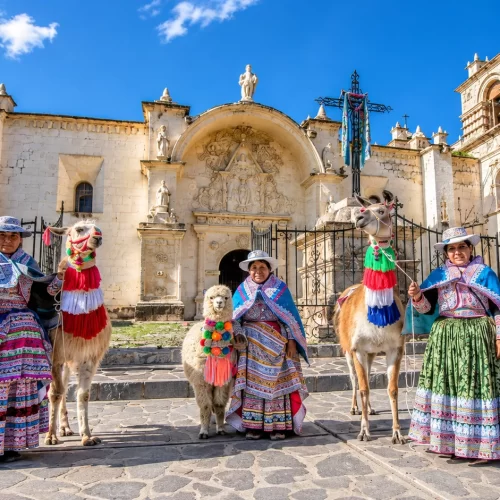
For the luxury traveler, exploring these four villages is an encounter with living ethnography. Here, local women wear breathtaking hand-embroidered velvet skirts and flat hats that distinguish their ancestral lineages; seventeenth-century churches carved from volcanic sillar stone shelter gilded altarpieces; and riverside thermal hot springs bubble naturally beside world-renowned luxury retreats like Belmond Las Casitas and Colca Lodge. At Peruvian Luxe, we curate private, unhurried cultural journeys through the Colca Valley, pairing insider access to colonial cloisters with private performances and bespoke five-star hospitality.
Planning your private cultural journey through the Colca Valley? Connect directly with Peruvian Luxe on WhatsApp to speak with our Andean cultural specialists.
The Cultural Tapestry: Collaguas, Cabanas & The Spanish Reducciones
To truly appreciate the villages of the Colca Valley, one must first uncover the deep ethnic divide that has shaped this canyon since the dawn of the first millennium. The valley is home to two distinct pre-Inca ethnic nations who coexisted in harmony while fiercely preserving their cultural independence:
The Collaguas (The High Valley Weavers)
Inhabiting the fertile upper and central valley—including Chivay, Yanque, and Coporaque—the Collaguas claimed divine descent from the snow-capped volcano Collaguata. Speaking a dialect of Aymara, they were master pastoralists who herded hundreds of thousands of alpacas and vicuñas, developing an extraordinarily sophisticated textile tradition. In pre-Columbian times, they practiced artificial cranial modification, binding infants’ skulls with wooden boards to create elongated, conical heads that mimicked the volcanic peak of their sacred ancestor.
The Cabanas (The Deep Canyon Farmers)
Inhabiting the warmer, deeper sections of the canyon around Cabanaconde, the Cabanas claimed descent from Mount Hualca Hualca. Speaking Quechua, they were agricultural virtuosos who specialized in growing rare varieties of high-altitude maize. Unlike the Collaguas, the Cabanas bound their infants’ heads flat and wide, wearing low, rounded felt hats adorned with intricate ribbon embroidery that continue to identify them today.
The Spanish Reducciones of 1570
When Spanish Viceroy Francisco de Toledo arrived in the Andes in the 1570s, he sought to control and Christianize these dispersed mountain populations. Toledo enacted the policy of Reducciones, forcibly relocating tens of thousands of indigenous families from ancient mountain citadels down into fourteen planned grid-pattern villages centered around vast central plazas.
Spanish architects and Franciscan friars trained indigenous Collagua stone masons to construct monumental churches using local white volcanic sillar stone. The result was the emergence of the Andean Baroque (or Mestizo Baroque) style—a visual syncretism where Christian angels were sculpted with indigenous facial features, and European acanthus leaves were replaced with cantuta flowers, pumas, and sacred Andean maize.
Chivay (3,635m): The Bustling Gateway & Artisan Market
Situated at the eastern entrance to the valley where the high Altiplano plateau drops into the river basin, Chivay (3,635 meters / 11,925 feet) is the administrative and commercial capital of the Caylloma province. While other villages in the valley are quiet pastoral hamlets, Chivay pulses with the energy of a historic Andean trading hub.
The Sensory Wonder of the Central Market
The beating heart of Chivay is its Mercado Central. A private morning walk through this bustling municipal market with a Peruvian Luxe guide offers an authentic, sensory introduction to highland agriculture:
- High-Altitude Apothecary: Stalls piled high with wild medicinal herbs gathered from the high punas—most notably muña (Andean mint used for digestion and altitude relief), chachacoma (used to combat mountain headaches), and dried eucalyptus leaves.
- Andean Superfoods: Sacks overflowing with dozens of varieties of native quinoa, kiwicha, giant white corn kernels, and freeze-dried potatoes (chuño and moraya) produced through traditional nocturnal freeze-drying techniques.
- Collagua Artisan Row: Local weavers selling hand-spun baby alpaca scarves, wool blankets, and hand-embroidered belts decorated with native flora and fauna motifs.
La Calera Thermal Baths
Located just three kilometers outside town along the banks of the river, La Calera features natural thermal springs emerging from the volcanic depths of Mount Cotalluni at temperatures exceeding 80°C (176°F), cooled into mineral-rich pools ranging between 36°C and 40°C (97°F to 104°F). Rich in sulfur, calcium, and magnesium, these waters have been used since Inca times to soothe aching joints and stimulate blood circulation after crossing the 4,910-meter Patapampa Pass.
Yanque (3,400m): The Cultural Capital, Mestizo Baroque & The Wititi Dance
Located just seven kilometers west of Chivay on the southern bank of the river, Yanque is widely considered the cultural crown jewel of the Colca Valley. As the ancient capital of the Collagua nation and the headquarters of Franciscan missionary efforts, Yanque exudes a dignified, historic tranquility.
The Church of the Immaculate Conception
Dominating the vast, cobblestone Plaza de Armas stands the Iglesia de la Inmaculada Concepción, constructed in the late seventeenth century. Its exterior facade, carved entirely from blinding white volcanic sillar stone, is one of the supreme masterworks of Andean Baroque architecture in the Americas.
Examining the facade reveals fascinating syncretic details:
- Flanking the main portal are twin carved stone sirens playing charangos (indigenous guitars crafted from armadillo shells).
- Above the central arch, Saint Anne and Saint Joachim stand framed by twisted Solomonic columns intertwined with native passionfruit vines and sacred Cantuta flowers.
- The massive detached bell tower houses bronze bells cast in the seventeenth century, ringing out across the terraced valley.
The Wititi Dance: UNESCO Intangible Cultural Heritage
Every morning between 06:30 AM and 07:15 AM, the main plaza of Yanque comes alive with a mesmerizing cultural ritual: the performance of the Wititi Dance (Danza del Wititi), officially inscribed by UNESCO on the Representative List of the Intangible Cultural Heritage of Humanity.
The Wititi is a traditional courtship dance that originated during pre-Inca times. Its most striking visual element is that the male dancers dress in female clothing—wearing layered, brightly embroidered velvet skirts (polleras) and female blouses. Andean oral history offers two fascinating explanations for this cross-dressing tradition:
- The Military Strategem: During the Inca conquest of the valley, Collagua warriors disguised themselves in women’s skirts to sneak past enemy outposts undetected before launching a surprise counter-attack.
- The Romance Ruse: Young suitors dressed in female attire to secretly court young noblewomen within rival ayllus without arousing the suspicion of protective fathers.
Watching local youth perform the dance to the energetic rhythms of live brass bands, twirling with sling-weapons (warakas) and feathered montera helmets, is an unforgettable cultural spectacle.
The Epicenter of Five-Star Luxury
Yanque is the premier base for luxury travelers visiting the region, home to the valley’s most prestigious luxury retreats. Here, properties like Belmond Las Casitas offer private standalone adobe villas featuring underfloor heating, wood-burning fireplaces, private plunge pools, and equestrian stables. Just down the valley along the riverbank, Colca Lodge Spa & Hot Springs provides private thermal mineral pools set directly into the river stone, surrounded by lush gardens and smoking chimneys.
Coporaque (3,570m): The Tranquil Agricultural Jewel of the North Bank
Directly across the river from Yanque lies the serene, rural village of Coporaque. Because commercial tourist buses almost exclusively travel along the southern road to Cruz del Cóndor, Coporaque and the entire northern bank of the Colca River remain an oasis of peaceful, authentic village life virtually untouched by mass tourism.
The Church of San Santiago: The Oldest in the Colca
Constructed around 1569 by Franciscan missionaries, the Iglesia de San Santiago in Coporaque is celebrated as the oldest surviving colonial church in the entire Colca Valley, and one of the earliest Franciscan temples in South America. Its simple, dignified stone facade, painted wooden doors, and freestanding stone belfry evoke the pioneering era of sixteenth-century Andean evangelization.
The Pre-Inca Citadel of Uyo Uyo
Just a short, gentle hike or private five-minute drive from Coporaque sits the ancient archaeological site of Uyo Uyo. This sprawling pre-Inca stone city served as the administrative capital of the Collagua curacazgo before the Spanish conquest. Walking among its well-preserved stone dwellings, circular grain storehouses, and active stone aqueducts—surrounded by flowering cacti and grazing llamas—provides an intimate window into pre-Columbian urban life without another tourist in sight.
Luxury Staging at Aranwa Pueblito Encantado
Coporaque is also home to Aranwa Pueblito Encantado del Colca, a luxurious five-star resort designed as a romantic, restored Andean hamlet. Set beside the murmuring Colca River, the property features its own organic farm, historic watermill, private astronomy observatory for stargazing under crystal-clear Altiplano skies, and an exquisite spa offering thermal hydrotherapy.
Maca (3,262m): The Resilient Terrace Village Beneath the Volcano
Continuing westward down the southern canyon road toward the condor viewpoints, the road brings you to Maca, a dramatic terrace village perched at 3,262 meters above sea level.
The Dazzling Church of Santa Ana
Maca’s central plaza is anchored by the Iglesia de Santa Ana, a blindingly white sillar church that gleams brilliantly against the dark volcanic mountainsides. Despite having been severely damaged by major regional earthquakes in 1991 and 2013, the resilient local community painstakingly restored the church to its original seventeenth-century glory.
Stepping through its hand-carved wooden doors reveals one of the most richly adorned Andean Baroque interiors in Southern Peru: immense gold-leaf wooden altarpieces, ornate silver tabernacles, and historic colonial statues clothed in hand-embroidered velvet garments created by local master artisans.
Living Beside an Active Volcano
Maca possesses an awe-inspiring, slightly thrilling geographical backdrop. Towering directly behind the village is Mount Sabancaya (5,976m), one of Peru’s most active stratovolcanoes. On clear mornings, you can watch dramatic white plumes of volcanic water vapor and steam puffing peacefully into the high-altitude sapphire sky, providing a humbling reminder of the immense tectonic forces that shaped this volcanic canyon.
Tasting the Traditional Colca Sour
In the village plaza of Maca, local fruit growers offer a quintessential regional specialty: the Colca Sour. Unlike a standard pisco sour made with lime juice, the Colca Sour incorporates the freshly squeezed juice of the Sancayo—a spiny, wild cactus fruit that grows on the vertical rock walls of the canyon. Intensely sour, loaded with Vitamin C, and balanced with pure cane syrup and premium pisco, it is the ultimate refreshing Andean aperitif.
Comparative Overview: The Four Traditional Villages at a Glance
The following summary table outlines the distinct character, elevations, and signature highlights of each village:
| Village Name | Elevation & Location | Cultural Identity | Masterpiece Church | Signature Experience | Luxury Accommodations |
|---|---|---|---|---|---|
| Chivay | 3,635m (11,925ft) Valley Gateway (South Bank) | Commercial trading hub & municipal center | Iglesia de Nuestra Señora de la Asunción | Exploring the Central Market & La Calera hot springs | Base hotels; access to nearby luxury lodges |
| Yanque | 3,400m (11,155ft) Central Valley (South Bank) | Historic Collagua capital & religious center | Iglesia de la Inmaculada Concepción (1690) | Morning Wititi dance performance & Chacapi hot springs | Belmond Las Casitas & Colca Lodge Spa |
| Coporaque | 3,570m (11,712ft) Quiet North Bank | Tranquil agricultural village & pre-Inca capital | Iglesia de San Santiago (c. 1569 – Oldest in Colca) | Hike through Uyo Uyo ruins & nighttime stargazing | Aranwa Pueblito Encantado del Colca |
| Maca | 3,262m (10,702ft) Canyon Edge (South Bank) | Resilient farming pueblo beneath Sabancaya | Iglesia de Santa Ana (Gilded gold-leaf altars) | Tasting wild Sancayo Colca Sours & volcano views | Day excursion stop en route to Cruz del Cóndor |
Curated Luxury Itinerary: Exploring the North & South Banks
To experience the authentic soul of the Colca Valley away from commercial bus crowds, Peruvian Luxe recommends our proprietary Dual-Bank Private Circuit:
Morning: The South Bank & Living Tradition
- 06:45 AM – Private Arrival in Yanque: Arrive in Yanque’s Plaza de Armas before tour groups to watch the vibrant, genuine performance of the UNESCO Wititi dance in the morning sunlight.
- 07:30 AM – Private Tour of the Mestizo Facade: Explore the Church of the Immaculate Conception with your private art historian guide, discovering hidden indigenous motifs.
- 08:30 AM – Scenic Drive to Maca: Journey westward along the rim, stopping in Maca to admire the gold-leaf altars of Santa Ana and savoring an artisanal Sancayo Colca Sour.
- 09:30 AM – Off-Peak Cruz del Cóndor: Continue to the viewpoint to witness Andean condors soaring effortlessly on rising morning thermal currents.
Afternoon: The Peaceful North Bank
- 12:30 PM – Crossing the River to Coporaque: Cross the ancient colonial stone bridge to the tranquil northern bank, escaping commercial traffic entirely.
- 01:00 PM – Riverside Gourmet Lunch: Savor regional Andean gastronomy—fresh trout with native herbs, quinoa risotto, and alpaca tenderloin—overlooking the river at Aranwa.
- 03:00 PM – The Ruins of Uyo Uyo & San Santiago Church: Take an unhurried, peaceful walk through the pre-Inca stone streets of Uyo Uyo and admire the oldest church in the valley in Coporaque.
- 05:00 PM – Return to Luxury Thermal Springs: Conclude your day soaking in private thermal mineral pools at Belmond Las Casitas or Colca Lodge with a glass of South American wine as the stars emerge above the canyon.
Learn more about choosing between a scenic drive versus active trekking in Colca Canyon, and explore our recommendations for Arequipa by evening as you plan your Southern Peru voyage.
Frequently Asked Questions About the Traditional Villages of Colca
Which village is the best to stay in during a luxury visit to the Colca Valley?
Yanque is widely considered the best village for luxury travelers. It is the cultural capital of the valley and is home to the region’s two most exclusive luxury retreats: Belmond Las Casitas (private standalone casitas with fireplaces and plunge pools) and Colca Lodge Spa & Hot Springs (featuring private natural thermal baths set into the riverbank). Coporaque is also an exceptional luxury option, home to Aranwa Pueblito Encantado del Colca on the quiet northern bank.
What is the Wititi dance, and where can I see it?
The Wititi is an ancient Andean courtship dance inscribed by UNESCO on the Representative List of the Intangible Cultural Heritage of Humanity. It is famed for its male dancers wearing female embroidered skirts (polleras) and feathered helmets, twirling with sling-weapons to live brass music. The dance is performed daily in the Plaza de Armas of Yanque between 06:30 AM and 07:15 AM.
Who are the Collaguas and Cabanas?
The Collaguas and Cabanas are two distinct pre-Inca ethnic groups who have inhabited the Colca Valley for over two thousand years. The Collaguas (Aymara-speaking) lived in the upper and central valley and were famed alpaca pastoralists who bound their heads into elongated cone shapes. The Cabanas (Quechua-speaking) lived in the deeper canyon and were expert maize farmers who bound their heads flat and wide. Both groups still wear distinctive traditional embroidered hats and clothing.
What is the oldest church in the Colca Valley?
The Church of San Santiago in the village of Coporaque is celebrated as the oldest church in the Colca Valley, built around 1569 by Franciscan missionaries. It features an iconic freestanding stone belfry and is considered one of the earliest Franciscan churches in South America.
What is the 'Bookshelf' sillar architecture seen in Colca churches?
The colonial churches in Colca—most notably in Yanque, Maca, and Chivay—were constructed using white volcanic sillar stone quarried from local volcanic deposits. Indigenous masons incorporated Andean Baroque carving techniques, decorating facades with native flora (cantuta flowers, passionfruit vines), indigenous sirens playing guitars, and sun motifs alongside Christian symbols.
What is a 'Colca Sour'?
A Colca Sour is a regional variation of Peru’s national cocktail, the Pisco Sour. Instead of standard lime juice, it is crafted using the juice of the wild Sancayo cactus fruit, which grows on the rocky cliffs of the Colca Canyon. The fruit has an intensely tart, citrus-like flavor rich in Vitamin C, creating a refreshingly tangy, vibrant cocktail. It is a signature drink in the village plaza of Maca.
How far are these villages from the Cruz del Cóndor viewpoint?
From Chivay, Cruz del Cóndor is approximately 50 kilometers (about 1.5 hours by scenic road). From Yanque, it is about 40 kilometers (1 hour and 15 minutes). Maca is located roughly halfway along this route, about 45 minutes from Cruz del Cóndor, making it an ideal intermediate stop for morning exploration.
What are the ruins of Uyo Uyo near Coporaque?
Uyo Uyo is a sprawling pre-Inca stone citadel located near Coporaque that served as the ancient administrative capital of the Collagua nation before Spanish contact. Visitors can walk through remarkably preserved stone houses, agricultural terraces, water canals, and burial chullpas surrounded by native flora without tourist crowds.
Is the altitude a problem in the Colca villages?
Yes, elevations range from 3,262m in Maca to 3,635m in Chivay, and getting to Colca requires crossing the 4,910m Patapampa Pass. We strongly recommend spending at least one or two days acclimatizing in Arequipa (2,325m) beforehand, staying well-hydrated, avoiding heavy meals upon arrival, and traveling in private luxury vehicles equipped with medical oxygen.
How does Peruvian Luxe arrange private tours of the Colca villages?
Peruvian Luxe arranges private, bespoke cultural journeys: private luxury SUVs with certified professional drivers, dedicated expert naturalist and cultural guides, private viewings of the morning Wititi dance in Yanque, exclusive explorations of the quiet northern bank (Coporaque and Uyo Uyo), and luxury suite reservations at Belmond Las Casitas and Colca Lodge.
Experience the Living Heritage of the Colca with Peruvian Luxe
To travel through the villages of the Colca Valley is to step into a timeless world where pre-Inca stone terraces still feed mountain communities, where colonial mestizo baroque churches glow white against volcanic peaks, and where ancient traditions like the Wititi dance are celebrated with authentic pride.
At Peruvian Luxe, our bespoke journeys allow you to experience the cultural soul of the canyon in peerless comfort. From five-star thermal hot spring suites at Belmond Las Casitas to private archaeologist guides and unhurried explorations of quiet northern-bank villages, every detail of your Andean expedition is tailored to perfection.
Begin designing your journey today. Contact Peruvian Luxe on WhatsApp and let us curate your private cultural voyage through the Colca Valley.