Contact us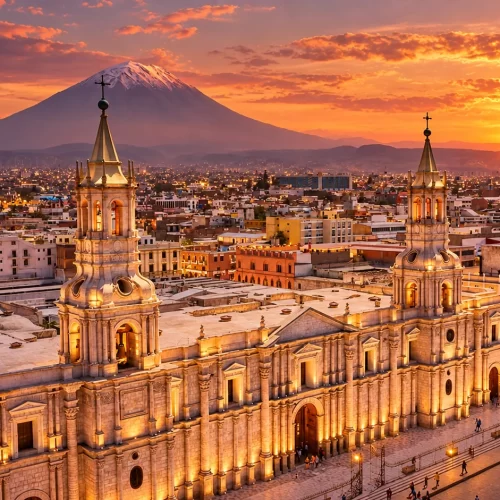
By day, Peru’s second city dazzles under relentless high-desert sunlight, its chalk-white volcanic masonry earning it the venerable moniker La Ciudad Blanca. Yet when the sun dips behind the jagged rim of the Cordillera Volcánica and the Andean twilight softens into violet, Arequipa by evening undergoes a breathtaking metamorphosis. The blinding glare dissolves into an intimate, warm radiance. Floodlights cast amber halos against meticulously chiselled baroque portals, while the volcanic ash-stone—porous, tactile sillar—seems to absorb and re-emit the warmth gathered through the afternoon.
Far below the snow-capped apex of Misti Volcano, Arequipa’s UNESCO-inscribed Historic Center transitions into an elegant nocturnal sanctuary. Across two-tiered neoclassical arcades, intimate rooftop terraces come alive with the clink of crystal tumblers carrying barrel-aged pisco and Andean botanicals. Tucked behind monumental wooden doorways, sixteenth-century cloistered courtyards fall into reverent silence, their stone fountains murmuring beneath star-strewn skies. For the luxury traveller seeking architectural sophistication, refined gastronomy, and evocative cultural walking routes, the evening hours reveal Arequipa’s most poetic and soulful dimension.
At Peruvian Luxe, we curate private evening journeys tailored to connoisseurs of heritage, gastronomy, and design. Whether sipping artisanal cocktails above the illuminated Plaza de Armas, stepping through candlelit monastic cloisters after closing hours, or enjoying a private tasting of Arequipeño haute cuisine, we unlock the White City’s evening magic with seamless discretion and insider access.
Planning your luxury escape to Southern Peru? Connect directly with Peruvian Luxe on WhatsApp to begin crafting your bespoke private journey.
The Alchemy of Sillar: Why Arequipa Glows After Dark
To understand the nocturnal allure of Arequipa, one must first understand its foundational medium: sillar stone. Formed millions of years ago by colossal pyroclastic flows from the surrounding stratovolcanoes—Chachani, Misti, and Pichu Pichu—this white volcanic ignimbrite possesses unique physical properties. It is exceptionally lightweight, malleable enough for indigenous sculptors to carve with surgical precision, and filled with micro-porosities that diffuse light rather than bouncing it harshly.
During the day, sillar reflects the intense high-altitude ultraviolet rays with such brilliance that colonial writers frequently compared walking Arequipa’s streets to traversing an alabaster canyon. But as dusk descends, something extraordinary takes place. Specialist architectural illumination, designed specifically to safeguard and highlight the historical fabric of the UNESCO zone, strikes the stone at oblique angles. Every carved acanthus leaf, cherub, rosette, and pre-Columbian sun symbol carved into church facades springs into three-dimensional relief, casting delicate graphite shadows across pearlescent surfaces.
Unlike limestone, granite, or brick, sillar has a warm, tactile translucency under soft artificial illumination. The monumental arches of the city center do not look cold or severe; rather, they project a gentle, golden glow that softens the monumental scale of the architecture. Strolling through these illuminated streets, visitors experience a timeless urban salon where Spanish colonial grandeur meets the volcanic soul of the Andes.
The Illuminated Plaza de Armas: Neoclassical Splendor Under the Stars
At the epicenter of Arequipa’s evening spectacle lies its grand Plaza de Armas, widely considered by architectural historians to be the most harmoniously proportioned civic square in South America. Unlike most colonial plazas across Spanish America, where church facades stand modest in comparison to royal palaces, Arequipa’s square is anchored along its entire northern perimeter by the monumental Basilica Cathedral of Arequipa.
Constructed from luminous white sillar, the Cathedral boasts an expansive facade spanning over one hundred meters, punctuated by seventy neoclassical columns, twin soaring bell towers, and three grand portals. By night, architectural uplighting bathes this colossal facade in a theatrical amber and cream illumination, highlighting the delicate symmetry of its cornices and balustrades against the inky blackness of the Andean sky.
The Grand Arcades (Portales de Arequipa)
Surrounding the other three sides of the Plaza are the magnificent two-story granite and sillar arcades known as the Portales:
- Portal de las Flores: Bordering the southern flank, famous for its elegant granite arches and lively café verandas.
- Portal de la Municipalidad: Anchoring the western side with civic balconies and polished flagstones.
- Portal de San Agustín: Lining the eastern edge, home to classic bookshops, heritage terraces, and sweeping sunset perspectives.
At the center of the manicured plaza, palm trees sway gently in the cooling evening mountain breeze around the historic bronze fountain crowned by El Tuturutu—a whimsical sixteenth-century winged trumpeter whose silhouette is framed by illuminated arches. Local families, university intellectuals, and refined travellers stroll the perimeter in a relaxed European-style passeggiata, free from the rushed cadence of daytime commercial life.
High Above the White City: Premier Rooftop Terraces and Sundowner Lounges
While walking the flagstones provides immediate contact with Arequipa’s volcanic history, the quintessential evening ritual belongs to the city’s elevated terraces. Positioned at an altitude of 2,325 meters (7,628 feet), Arequipa enjoys dry desert air with exceptional atmospheric clarity. At twilight, known locally as the blue hour, the sky shifts from burnt terracotta to deep cobalt, creating a dramatic halo around the conical silhouette of Misti Volcano (5,822m) looming just seventeen kilometers away.
For the luxury traveler, this is the magic hour to secure a private veranda or rooftop lounge table, wrap oneself in an ultra-fine baby alpaca throw, and savor Peru’s national spirit elevated through modern mixology.
Curated Rooftop Venues for Sunset & Evening Libations
| Venue & Setting | Prime Location | Visual Panorama | Signature Evening Experience |
|---|---|---|---|
| Katari Bar & Terrace | Portal de San Agustín, Plaza de Armas | Direct eye-level views of the Cathedral’s illuminated bell towers and El Misti | Artisanal Pisco Sour infused with muña (Andean mint) and cured rocoto chili bitters |
| CIRQA Patio & Rooftop | Calle Agustín Lira (Luxury Relais & Châteaux) | Secluded monastic rooftops, restored 1540 sillar vaulted arches, private chimney fires | Small-batch botanical gins distilled with high-Andean herbs and local desert citrus |
| Terraza Arequipa Suites | Calle Rivero, Historic Center | Expansive 360-degree cityscape capturing the three volcanic sentinels | Tasting flight of artisanal South Peruvian piscos paired with artisanal cheeses |
| Mirador Misti Lounge | Portal de las Flores | Sweeping angle over the entire Plaza fountain and cathedral balustrades | Chilcano de Pisco with passion fruit, fresh ginger extract, and organic cane syrup |
| Yanahuara Mirador Terrace | Plaza Yanahuara (Canyon overlook) | City lights glistening across the Chili River basin with framed sillar arches | Majes Valley dry red wines paired with savory regional charcuterie |
The Pisco & Anisado Evening Connoisseurship
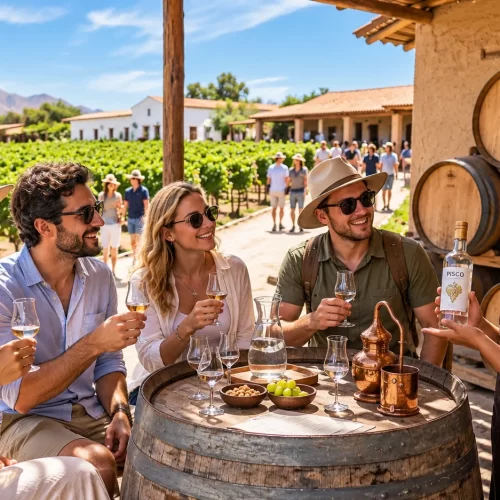
Arequipa is the historic gateway to Southern Peru’s premier coastal wine and pisco valleys, notably the deep, sun-drenched canyons of Majes and Vítor. Rooftop evenings in Arequipa are the ideal setting to sample single-estate Mosto Verde piscos—luxurious, velvet-textured spirits distilled from partially fermented grape musts of Quebranta, Italia, and Torontel varietals.
Equally historic is Arequipa’s traditional digestive: Anisado. Produced for over a century in nearby Curahuasi, this aromatic anise liqueur is traditionally served neat or with a single hand-carved ice sphere following rich evening dinners, warming the palate as the desert night chill settles over the rooftops.
Santa Catalina by Candlelight: The Nocturnal Monastery Experience
No exploration of Arequipa by evening is complete without experiencing the legendary Santa Catalina Monastery under nocturnal lighting. Spanning more than twenty thousand square meters within the city’s historic core, this sixteenth-century Dominican convent functioned for nearly four centuries as an entirely secluded city within a city.
While a daylight visit reveals brilliant cobalt-blue corridors, sunlit orange cloisters, and flowering bougainvillea, the exclusive evening candlelight visits—conducted on selected nights—transport visitors into another century altogether. Electric lighting within the monastic complex is virtually nonexistent during these twilight hours; instead, rustic wrought-iron lanterns and hundreds of tallow candles illuminate the stone flagstones, arched doorways, and secluded confessionals.
Walking the Candlelit Streets of Seville and Granada
Strolling through named internal alleys such as Calle Córdoba, Calle Sevilla, and Calle Toledo in near-total silence evokes an eerie, sublime tranquility. The massive sillar walls, washed in historic lime paints of terracotta and mineral blue, flicker beneath dance of candlelight. Shadows stretch across stone baptismal fonts, communal laundry troughs carved from halved earthenware jars, and private cell gardens where cloistered nuns once meditated beneath the southern celestial constellations.
Peruvian Luxe coordinates private access with seasoned art and architectural historians, allowing you to bypass daytime crowds and encounter this sacred enclave in atmospheric contemplation. The ambient hush, broken only by your footsteps on ancient river stones and the faint whisper of mountain wind through courtyard orange trees, offers one of the most poignant spiritual and aesthetic experiences in all of South America.
Secret Courtyards and Quiet Casonas: A Stroll Through Colonial Silence
Beyond the grand public squares, Arequipa’s true architectural soul resides behind the fortress-like wooden gates of its grand colonial mansions (casonas) and historic transport hubs (tambos). Due to the seismic nature of the volcanic valley, colonial architects perfected an earthquake-resistant design: single-story residences constructed with walls up to 1.5 meters thick, crowned by soaring barrel-vaulted sillar ceilings and centered around tranquil interior courtyards (patios).
Claustros de la Compañía de Jesús
Situated just steps from the southeastern corner of the Plaza de Armas, the Cloisters of the Society of Jesus represent the undisputed peak of Andean mestizo baroque architecture. Built in the seventeenth century, its central courtyard is bordered by sweeping sillar arcades whose pillars are carved with dizzying stone reliefs depicting native flora, jungle cantuta flowers, winged angels with indigenous facial features, and roaring pumas.
In the evening, the inner courtyard is subtly illuminated, accentuating the hyper-detailed carvings while shielding guests from outside street noise. Today, this peaceful cloister houses discreet artisan galleries, premier baby alpaca boutiques, and upscale wine lounges where guests can linger under stone vaults while sipping regional vintages.
Casona Tristán del Pozo & Casa del Moral
A tranquil evening stroll north of the Plaza brings you past some of the continent’s finest residential facades:
- Casona Tristán del Pozo: Renowned for its monumental sillar portal carved with a lush “Tree of Life” springing from an Andean cantuta flower pot, presided over by five ornate rosettes. Illuminated softly after dark, the entrance stands as a masterwork of syncretic stonecraft.
- Casa del Moral: Named after a three-hundred-year-old mulberry tree flourishing in its main cobblestone patio, this eighteenth-century manor displays noble coats of arms, intricate wrought-iron window grilles, and an intimate courtyard that feels untouched by modern centuries.
The Historic Tambos: Living Urban Heritage
For travellers interested in living vernacular history, wandering into restored colonial tambos—such as Tambo de Bronce or Tambo de la Cabezona near the Chili River—reveals the communal courtyards where mule trains and merchants arriving from the silver mines of Potosí and the Pacific port of Islay unloaded cargo centuries ago. Under warm lamplight, these interconnected sillar alleys showcase the enduring daily life of local artisans and historic preservation projects.
Evening Gastronomy: Haute Picanterías, Volcanic Stone Grills & Modern Andean Cuisine
No evening in Arequipa is complete without participating in the city’s UNESCO-designated Creative City of Gastronomy heritage. Arequipa’s culinary tradition is distinct from Lima’s coastal ceviche culture and Cusco’s high-altitude root-based cooking. It is a hearty, deeply aromatic cuisine born from the fertile volcanic countryside, historically perfected in neighborhood picanterías where clay wood-burning stoves (fogones) and fermented corn beer (chicha de jora) reign supreme.
While traditional picanterías are bustling lunchtime institutions, the evening in Arequipa belongs to visionary restaurateurs who have reinterpreted this deep heritage through sophisticated, world-class dining rooms.
Premier Evening Dining Destinations
- Chicha por Gastón Acurio: Housed within the vaulted sillar chambers of the Santa Catalina quarter, overlooking the illuminated river stone plaza. Here, legendary chef Gastón Acurio pays homage to regional flavors with elevated presentations of Rocoto Relleno (sweet-spiced stuffed pepper with potato gratin), suckling pig confit, and local trout carpaccio.
- Zig Zag Restaurant: Situated on charming Plaza San Francisco, Zig Zag pioneered dining on volcanic stones. Guests enjoy tender cuts of alpaca tenderloin, beef tenderloin, and Andean lamb seared tableside on volcanic granite slabs heated to searing temperatures, complemented by delicate Andean potato mousselines and South American vintage wines.
- 13 Monjas: Tucked into a chic colonial sillar enclave on Calle Santa Catalina, offering craft cocktails, gourmet wood-fired sourdough pizzas, artisanal charcuterie, and an intimate open-air courtyard vibe favored by Arequipa’s creative elite.
- Salamanto Restaurante: An avant-garde culinary temple focusing on micro-seasonal ingredients sourced strictly from Arequipa’s volcanic valleys, high puna plateaus, and coastal waters, served as a multi-course gastronomic journey paired with rare local beverages.
For dessert, indulge in an authentic evening portion of Queso Helado. Despite its name (“iced cheese”), this decadent treat contains no cheese whatsoever; rather, it is an exquisite frozen confection made from evaporated milk, condensed milk, cinnamon, cloves, and toasted coconut flakes, hand-churned in wooden barrels lined with ice and rock salt.
Curated Evening Walking Itinerary & Safety Guidelines
Arequipa’s Historic Center is one of the most civilized, walkable, and secure urban districts in Latin America. Extensive pedestrianization across historic corridors—most notably Calle Santa Catalina and Calle Mercaderes—allows visitors to explore comfortably on foot without the intrusion of vehicular noise or exhaust fumes.
A Recommended 3-Hour Evening Walking Circuit
- 5:30 PM – Sunset at Yanahuara Mirador: Begin slightly outside the core district at the scenic overlook of Yanahuara. Gaze through carved eighteenth-century sillar arches inscribed with verse by Arequipa poets, taking in the panoramic vista of the illuminated city below as El Misti captures the final alpenglow.
- 6:15 PM – Descent to Calle Santa Catalina: Travel by private chauffeured car down across the Bolognesi Bridge into the pedestrianized section of Calle Santa Catalina. Admire the exterior floodlit walls of the monastery and artisan concept stores.
- 6:45 PM – Plaza de Armas & Cathedral Stroll: Step into the grand Plaza as the illumination reaches full radiance. Take time to photograph the Cathedral’s monumental facade and circle the Portales.
- 7:30 PM – Rooftop Sundowner: Ascend to a private terrace table at Katari or Portal de San Agustín for an artisanal pisco cocktail as the bells toll.
- 8:15 PM – Fine Dining Reservation: Conclude with a table at Chicha or Zig Zag, surrounded by the vaulted thermal sillar architecture.
Practical Considerations: Climate, Altitude & Attire
Because Arequipa sits on the arid southern volcanic plateau at 2,325 meters, the daytime heat rapidly gives way to crisp, dry evening temperatures dropping between 8°C and 12°C (46°F to 54°F). Sophisticated layering is essential: fine-gauge cashmere or authentic baby alpaca sweaters, structured trench coats or tailored wool jackets, and elegant walking shoes suited for polished colonial cobblestones.
Compared to Cusco (3,400m) or Lake Titicaca (3,812m), Arequipa’s lower elevation provides an ideal physiological stepping stone for altitude acclimatization before heading deeper into the Andes or exploring luxury Colca Canyon lodges. The moderate altitude allows you to enjoy evening walks and fine wines without the acute fatigue or oxygen deprivation common at higher altitudes.
Continuing Your Bespoke Peruvian Journey
An evening in Arequipa pairs flawlessly with an expansive South American itinerary. Many of our guests combine the architectural grandeur of the White City with the drama of the condor-soaring depths of Colca, followed by the nocturnal mystique of the ancient Inca capital detailed in our guide to Cusco by night and its illuminated plazas. Wherever your aspirations lead across Peru, Peruvian Luxe ensures each destination unfolds with unmatched elegance, private access, and unforgettable hospitality.
Frequently Asked Questions About Arequipa by Evening
Is Arequipa safe to walk around in the evening?
Yes, Arequipa’s Historic Center is widely considered one of the safest and most pedestrian-friendly urban cores in Peru. The main tourist areas—including the Plaza de Armas, Calle Santa Catalina, Calle San Francisco, and the surrounding pedestrian corridors—are well-lit, actively monitored by municipal tourist police (Policía de Turismo), and frequented by locals and international visitors well into the late evening. As in any international city, basic vigilance regarding personal belongings is recommended, and private chauffeured transfers are advised when traveling outside the central historic perimeter after dark.
What makes Arequipa's sillar architecture glow at night?
Sillar is a porous, chalk-white volcanic ignimbrite stone formed from ancient pyroclastic deposits of Misti and Chachani volcanoes. Its granular, micro-porous texture naturally diffuses and softens artificial light rather than creating harsh, flat reflections. When illuminated by warm amber and golden architectural floodlights at night, the stone appears to radiate an internal warmth, highlighting the hand-carved baroque facades and creating the city’s celebrated golden nocturnal aura.
When is the best time of evening to visit Arequipa's rooftop terraces?
The optimal time to arrive at a rooftop terrace is between 5:15 PM and 5:45 PM. This window allows you to witness the twilight transition (the blue hour), when the golden alpenglow fades from the snow-capped peak of Misti Volcano and the sky deepens into vivid cobalt and violet, followed immediately by the illumination of the Basilica Cathedral and the neoclassical Plaza de Armas arcades around 6:00 PM.
Can you visit Santa Catalina Monastery at night?
Yes, the Santa Catalina Monastery hosts special evening visits on selected days (traditionally Tuesdays and Wednesdays until approximately 8:00 PM). During these nocturnal sessions, electric lighting is kept to an absolute minimum, and the historic cobblestone streets, vibrant cloisters, and ancient monastic cells are illuminated by candlelight and wrought-iron lanterns, creating an unforgettable and reverent historical atmosphere. Peruvian Luxe arranges private guided evening access for our guests.
What should I wear for an evening out in Arequipa?
Due to Arequipa’s dry high-desert climate at 2,325 meters, evening temperatures drop noticeably after sunset, typically hovering between 8°C and 12°C (46°F to 54°F). We recommend smart-casual to elegant layering: fine wool or baby alpaca knits, light blazers, cashmere scarves, and stylish, comfortable walking shoes suitable for polished cobblestones and historic stone flagstones.
What are the best rooftop bars overlooking the Plaza de Armas?
The premier rooftop terraces overlooking the Plaza de Armas include Katari Bar & Terrace (located on Portal de San Agustín, offering front-row vistas of the Cathedral bell towers and Misti), Mirador Misti Lounge on Portal de las Flores, and the terrace at Portal de la Municipalidad. For a more secluded luxury setting, the private courtyard and rooftop terraces at CIRQA (Relais & Châteaux) offer bespoke cocktails surrounded by 16th-century sillar vaults.
What traditional cocktails or drinks should I try in Arequipa by evening?
In addition to classic Peruvian Pisco Sours made with coastal Quebranta or Mosto Verde piscos from the nearby Majes and Vítor valleys, you should try botanical chilcanos infused with local herbs like muña (Andean mint) and tumbo (wild passionfruit). For an authentic post-dinner digestive, savor traditional Curahuasi Anisado, an aromatic anise liqueur served neat or on ice.
Is altitude an issue during evening walks in Arequipa?
Arequipa sits at a moderate elevation of 2,325 meters (7,628 feet), which is significantly lower than Cusco (3,400m) or Lake Titicaca (3,812m). Most travelers do not experience acute altitude sickness in Arequipa, making it an ideal acclimatization destination. However, the dry climate can cause mild dehydration, so pairing cocktails with plenty of bottled mineral water is always advised during evening strolls and dinners.
What are the top fine dining restaurants in Arequipa for evening dinners?
Arequipa’s finest evening dining establishments include Chicha por Gastón Acurio (celebrated for contemporary interpretations of traditional picantería recipes in a vaulted sillar manor), Zig Zag Restaurant (famed for alpaca and beef tenderloins seared on sizzling volcanic stones), 13 Monjas (chic Mediterranean-Andean courtyard dining), and Salamanto (an avant-garde tasting menu dedicated to regional volcanic terroirs).
How does Peruvian Luxe arrange private evening experiences in Arequipa?
Peruvian Luxe designs fully bespoke evening itineraries tailored to your preferences. Our services include private chauffeured transfers, expert architectural and art historian guides for twilight walking tours, VIP reserved terrace tables timed for the cathedral illumination, private after-hours or candlelight monastery tours, and privileged reservations at Arequipa’s leading gastronomic venues.
Experience the Magic of Arequipa by Evening with Peruvian Luxe
The White City by day is a marvel of volcanic stone and Andean sunshine, but by night, it belongs to those who appreciate the quiet poetry of illuminated cloisters, the amber warmth of glowing sillar facades, and the relaxed sophistication of rooftop terraces framing volcano silhouettes under starry southern skies.
At Peruvian Luxe, we ensure your time in Arequipa is curated to perfection. From reserving the most panoramic sundowner table on the Plaza de Armas to arranging private candlelit walks through centuries of monastic history and securing the finest dining tables in the city, our local specialists handle every detail with flawless professionalism and discretion.
Let us design your bespoke Peruvian luxury journey. Contact Peruvian Luxe on WhatsApp today and discover Southern Peru at its most enchanting.