Contact us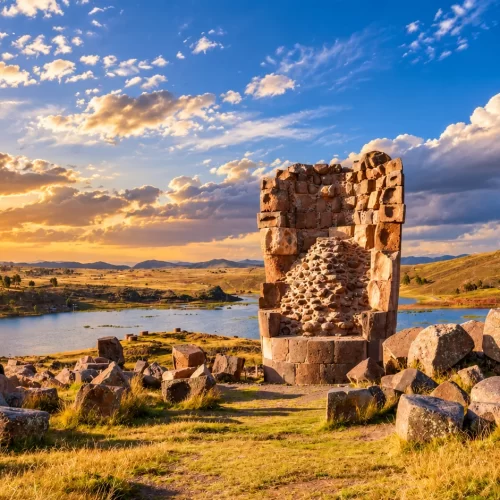
On a dramatic peninsula of windswept altiplano jutting into the still waters of Lake Umayo, some 34 kilometers north of Puno, a civilization raised its dead toward the sky. The Sillustani chullpas — cylindrical funeral towers of dressed stone rising up to 12 meters from the earth — are among the most architecturally ambitious and visually striking monuments of the entire pre-Columbian Andes. Built by the Collao culture and later adapted and expanded by the Inca, these towers were not temples or fortresses but tombs — elaborate, permanent, and deliberately monumental expressions of a culture’s relationship with death, ancestry, and the cosmos.
Sillustani is one of Peru’s most underappreciated archaeological sites — less famous than Machu Picchu, less visited than Cusco’s ruins, and entirely unlike either. Where the great Inca monuments celebrate political power and solar religion, Sillustani speaks a different language: one of ancestral reverence, funerary grandeur, and the stark, enormous beauty of the altiplano at the edge of the world. The landscape alone — the towers silhouetted against the vast Andean sky, the lake reflecting the last light of day — is worth the journey.
At Peruvian Luxe, we design private Sillustani visits timed precisely for the late afternoon — arriving as the low sun begins its descent toward the Andes and the chullpas cast their longest, most dramatic shadows across the peninsula. A private guide, a specialist historian, unhurried time among the towers, and a sundowner on the lakeshore afterward: this is how Sillustani deserves to be experienced.
Planning a visit to Puno and Lake Titicaca? Contact Peruvian Luxe on WhatsApp and let us design your perfect altiplano itinerary.
History of Sillustani: The Collao Culture and Their Towers to the Sky
To understand the Sillustani chullpas, one must first understand the civilization that built them. The Collao culture (also called the Lupaca kingdom) was one of the most powerful Aymara-speaking polities of the Lake Titicaca basin, flourishing between approximately 1000 CE and 1450 CE — long before the Inca incorporated this region into their empire. The Collao were herders, traders, and builders of remarkable sophistication, whose political and ceremonial center was located at Chucuito on the shores of Lake Titicaca.
For the Collao, the relationship between the living and the dead was not one of separation but of continuous engagement. Ancestors were not buried and forgotten — they were preserved, honored, and consulted. The dead remained members of the community, their mummified bodies housed in permanent stone structures where they could receive offerings, participate in festivals, and intercede with the divine on behalf of the living. The chullpa was not a grave; it was a house — a permanent, architecturally ambitious home for the honored dead.
Why Cylindrical? The Architecture of the Chullpa
The most immediately striking feature of the Sillustani towers is their form: tall, circular cylinders of dressed stone that taper inward at the base and flare outward at the top — an intentional architectural inversion that defies structural logic and creates a form of arresting visual drama. The reason for this unusual shape remains debated among archaeologists, but the most widely accepted interpretation connects it to the Aymara concept of pacha — the layered cosmos in which the world of the living and the world of the ancestors exist in parallel, connected through monuments that reach toward the sky.
The finest chullpas at Sillustani — including the celebrated Chullpa del Lagarto (Lizard Tower) — are constructed from large, precisely fitted blocks of sandstone and andesite cut with a technical mastery that rivals the finest Inca stonework. The blocks interlock without mortar, their surfaces dressed to a smooth finish and fitted with sub-millimeter precision. The exterior surface of the finest towers features carved relief decoration: serpent motifs, lizard figures, and geometric patterns whose precise symbolic meaning remains only partially understood.
The Inca Period: Expansion and Elaboration
When the Inca conquered the Lake Titicaca basin in the mid-15th century under Pachacuti, they absorbed the chullpa tradition rather than suppressing it. Inca builders added their own towers to the Sillustani complex, bringing their characteristic polygonal masonry technique and introducing a more refined surface finish. The result is a site that layers two distinct architectural traditions — Collao and Inca — in a way that allows careful observers to trace the evolution of Andean funerary architecture across several centuries of development.
The Inca also expanded the ceremonial importance of the site. Sillustani became a place of pilgrimage for the entire Lake Titicaca region — the towers of the most powerful Collao lords serving as focal points for ancestor veneration rituals that the Inca incorporated into their own imperial religious calendar.
Spanish Conquest and the End of the Chullpa Tradition
The arrival of Spanish colonizers in the 16th century brought the chullpa tradition to an abrupt end. The Catholic Church’s prohibition of ancestor veneration and the systematic desecration of indigenous burial sites — carried out by extirpators of idolatry who broke open chullpas to remove and destroy mummies and offerings — effectively severed the living relationship between the Aymara communities and their honored dead. Many of the Sillustani towers were damaged during this period; the mummies they contained were removed or destroyed.
What survived — the stone towers themselves, emptied but architecturally intact — became the monument we visit today: a place where the physical legacy of a sophisticated funerary culture can still be read clearly in stone, even as the living ritual context that gave it meaning was systematically erased.
The Chullpas of Sillustani: A Detailed Guide to the Site
The Sillustani archaeological complex occupies a peninsula of approximately 40 hectares extending into Lake Umayo — a shallow, reed-fringed lake at 3,860 meters altitude, connected by a narrow channel to the broader Lake Titicaca basin. The site contains more than 90 individual chullpas in various states of preservation, ranging from partially collapsed mounds of dressed stone to near-complete towers of exceptional quality.
The Chullpa del Lagarto (Lizard Tower)
The most celebrated individual structure at Sillustani is the Chullpa del Lagarto — named for the carved lizard relief visible on its exterior face. Standing approximately 12 meters tall, this is both the tallest surviving chullpa at Sillustani and the finest example of Collao stonework at the site. The blocks are fitted with extraordinary precision, the exterior surface smooth and carefully dressed, and the characteristic outward flare of the upper section is fully preserved.
The carved lizard is particularly significant: in Aymara cosmology, the lizard (or serpent) is associated with the lower world — the realm of ancestors and the dead — making its presence on a funerary tower a deliberate and meaningful iconographic choice rather than mere decoration. Look also for the carved serpent motifs running along the tower’s upper register — a recurring element across multiple Sillustani towers that reinforces the site’s consistent ancestral symbolic language.
The Inca Chullpas: Technical Mastery in Stone
Several towers at Sillustani display the distinctive characteristics of Inca-period construction: polygonal stone blocks of varying size fitted together in the Inca’s characteristic irregular mosaic pattern, with no two blocks the same shape and all fitted without mortar to extraordinary tolerances. These towers tend to be slightly more regular in cross-section and more refined in surface finish than the Collao examples, reflecting the different but equally sophisticated stone-working tradition of the Cusco-based empire.
The juxtaposition of Collao and Inca construction styles within the same site — sometimes within meters of each other — makes Sillustani an unusually rich site for understanding the architectural continuities and differences between two of the Andes’ most technically accomplished pre-Columbian building traditions.
The Incomplete Tower: A Window into Construction Techniques
One of the most instructive features at Sillustani is an unfinished chullpa — a tower whose construction was halted at approximately half its intended height, leaving the building process itself frozen in time. The incomplete tower reveals how Sillustani’s builders worked: stones are still in the process of being fitted, construction ramps of earth and smaller stones remain in place, and the sequence of block placement can be clearly read from the exposed construction face.
Archaeological analysis of the incomplete tower suggests that construction may have been halted by the arrival of the Spanish — an interpretation that, if correct, means the tower has stood in its unfinished state for nearly 500 years: an inadvertent monument to the violent disruption of Andean civilization by the European conquest.
The Lake Umayo Setting
The chullpas of Sillustani do not stand in isolation — they are inseparable from the landscape that surrounds them. Lake Umayo, the shallow plateau lake into which the Sillustani peninsula extends, provides a mirror surface for both the towers and the vast Andean sky, creating a visual context of extraordinary spatial drama. The lake supports populations of puna ibis, Andean flamingos, giant coots, and the endemic Titicaca grebe — making the site rewarding for birdwatchers as well as archaeologists.
In the distance, on a clear day, the snow-capped peaks of the Cordillera Real in Bolivia are visible across the altiplano — a reminder that Sillustani sits at the center of one of the world’s great high-altitude landscapes, a terrain that shaped every aspect of the culture that built these towers.
The Sillustani Sunset Experience: Why Timing Your Visit Matters
Sillustani can be visited at any time of day, but the site reaches its absolute peak of visual and atmospheric drama during the late afternoon and sunset hours. The combination of factors that converge in these final hours of daylight creates an experience fundamentally different from a midday visit — and one that Peruvian Luxe designs all its Sillustani programs around.
The Light: Altiplano Gold Hour
At 3,860 meters altitude, the altiplano receives some of the most intense sunlight in the world — but it is the quality of the light in the final 90 minutes before sunset that transforms Sillustani. The low-angle sun illuminates the towers from the side, deepening every joint between stone blocks and casting long shadows that emphasize the architectural texture and mass of the chullpas. The local sandstone and andesite, neutral gray in midday light, warm to deep amber and terracotta in the late afternoon. The lake surface turns to hammered gold, then rose, then a deepening crimson as the sun approaches the horizon.
For photography, the Sillustani sunset is one of the finest natural set-piece opportunities in the entire Peru circuit — combining iconic monumental forms, extraordinary natural light, and a landscape of vast, austere beauty. Peruvian Luxe can arrange a private photography guide for guests who want to maximize the visual potential of their visit.
The Silence and the Wind
The altiplano wind at Sillustani is a constant presence — rarely still, frequently cold, and entirely characteristic of the high plateau. In the late afternoon, as the sun descends, the wind typically strengthens and the temperature drops noticeably. This is not merely a weather inconvenience: the combination of wind, cold, vast sky, and monumental silence creates an atmospheric intensity that is uniquely suited to a funerary site. The chullpas were built for this landscape, in this wind, under this sky. Experiencing them at the end of the day — when the light is going and the cold is coming — brings the visitor as close as is possible to the emotional register for which the site was designed.
Sundowner on the Lakeshore
Peruvian Luxe arranges a private lakeshore sundowner as the conclusion of every Sillustani visit — a table set on the shore of Lake Umayo with the towers visible on the peninsula above, pisco cocktails and warm alpaca blankets against the altiplano chill, and the sky performing its final chromatic display over the Bolivian peaks. This moment of elevated comfort after the archaeological experience is one of the most genuinely memorable transitions in the entire Peru luxury itinerary.
Sillustani Within the Wider Puno and Lake Titicaca Itinerary
Sillustani is located 34 kilometers northwest of Puno on a paved road — approximately 45 minutes by private vehicle. It functions naturally as a half-day excursion from Puno, typically combined with other elements of the Lake Titicaca experience to create full-day or multi-day itineraries of exceptional richness and variety. Peruvian Luxe designs Sillustani visits as integral components of wider Puno programs rather than isolated day trips.
Combining Sillustani with Chucuito Village
The most natural pairing for a Sillustani afternoon visit is a morning spent in Chucuito — the former capital of the Lupaca-Collao kingdom, located 18 kilometers south of Puno on the shores of Lake Titicaca. Chucuito’s two colonial churches (Santo Domingo and Nuestra Señora de la Asuncion) are among the finest examples of 16th and 17th-century provincial colonial architecture in southern Peru, built directly over the foundations of Collao ceremonial structures — a physical layering of cultures that is visible in the stones themselves.
The village also contains the controversial Templo de la Fertilidad (Temple of Fertility) — an enclosure containing numerous stone phallus sculptures of disputed archaeological authenticity. Whatever the scholarly debate about the temple’s origins, it generates substantial visitor interest and raises questions about the relationship between pre-Columbian fertility religion and colonial-era construction that are worth exploring with a specialist guide.
The Sillustani and Uros Combination
For visitors with a single day in Puno, Peruvian Luxe recommends a program that combines a morning visit to the Uros Floating Islands with an afternoon at Sillustani. The contrast between the two experiences is instructive and dramatically satisfying: the Uros islands represent a living indigenous culture on the lake’s surface — vibrant, dynamic, and intensely connected to the reed-based ecology of the lake; Sillustani represents a vanished civilization’s most permanent statement — monumental, silent, and oriented toward the sky rather than the water.
The Approach Road: Altiplano Landscape as Experience
The 45-minute drive from Puno to Sillustani traverses some of the most characteristic altiplano landscape in the entire Lake Titicaca basin — high, windswept grassland dotted with grazing alpacas and llamas, traditional Aymara farmsteads built from adobe and thatched with ichu grass, and distant views of snow-capped Bolivian peaks across the altiplano horizon. Peruvian Luxe ensures this journey is made in a comfortable private vehicle with a guide who can explain the agricultural and social landscape as you pass through it — transforming the transit into an integral part of the cultural experience.
Sillustani in the Context of Andean Death Ritual
For visitors with a deeper interest in Andean religious thought and mortuary practice, Peruvian Luxe can arrange a specialist lecture or briefing — delivered either at the site or at your hotel in Puno — that contextualizes Sillustani within the broader landscape of pre-Columbian Andean death ritual. Topics covered include:
- The Andean concept of mallqui — the mummy bundle as a living social agent in Andean communities
- The role of ancestor veneration in Collao and Inca political legitimation
- The architectural and symbolic relationship between chullpas and the Aymara three-world cosmology (Alax Pacha, Aka Pacha, Manqha Pacha)
- The Spanish extirpation of idolatry campaigns and their catastrophic impact on Andean funerary traditions
- Contemporary Aymara death rituals and their continuities with pre-Columbian practice
Practical Guide: Planning Your Private Visit to Sillustani
Key Visit Information
| Detail | Information |
|---|---|
| Location | 34 km northwest of Puno, Puno Region, Peru — 45 minutes by private vehicle |
| Altitude | 3,860 meters above sea level — proper acclimatization essential |
| Opening Hours | Daily 8:00 AM – 6:00 PM (last entry 5:30 PM) |
| Best Visit Time | 3:00 PM – 5:30 PM for late afternoon and sunset light |
| Recommended Duration | 2 hours on-site (private guide); 3.5 hours including travel from Puno and lakeshore sundowner |
| Photography | Fully permitted; no restrictions. Best subjects: Chullpa del Lagarto, lake reflections, silhouetted towers at sunset |
| Terrain | Uneven rocky paths and hillside trails; sturdy walking shoes essential; moderate fitness required |
| Weather | Cold wind in afternoon — bring thermal layers, windproof jacket; temperatures can fall below 5°C after sunset |
Altitude and Health Considerations
At 3,860 meters above sea level, Sillustani is one of the higher-altitude sites visited on the standard Peru luxury itinerary — only Lake Titicaca itself and the Patapampa Pass on the Arequipa–Colca road exceed it in typical programs. Proper acclimatization is essential before visiting. Peruvian Luxe always schedules Sillustani visits for the second or third day in Puno — never on the first day of arrival at altitude — and provides full altitude awareness guidance including:
- Coca tea and mate de muña (a native Andean herb with mild altitude-relief properties) provided throughout the visit
- Portable supplemental oxygen available in all private vehicles as standard equipment
- Itinerary pacing specifically designed to minimize physical exertion on the first day at altitude
- Pre-trip altitude preparation advice including dietary recommendations and optional prescription medication consultation
What to Wear and Pack for Sillustani
- Thermal base layer — the altiplano cold is deceptive; even on sunny days, the wind chill at 3,860m is significant
- Windproof and waterproof mid-layer — afternoon wind at Sillustani can be strong and cold
- Sturdy walking shoes or light hiking boots — the site paths are rocky and uneven
- Sun protection — SPF 50+ sunscreen and UV-protective sunglasses; altiplano UV intensity is extreme even on cool days
- Camera with wide-angle lens — the scale of the chullpas against the lake and sky demands wide coverage; telephoto useful for carved detail on the Chullpa del Lagarto
- Warm hat and gloves — non-negotiable for the sunset and post-sunset period
Best Time of Year to Visit Sillustani
| Season | Months | Conditions | Recommendation |
|---|---|---|---|
| Dry season | May–October | Clear skies, cold nights (-5°C to 5°C), excellent visibility, minimal rain | Best overall — clearest skies for photography and sunset; coldest nights require warm gear |
| Wet season | November–April | Afternoon rain common; mornings usually clear; altiplano is brilliantly green | Good in mornings; afternoon visits risk cloud and rain blocking sunset — morning visits recommended |
| Shoulder seasons | April–May, Oct–Nov | Transitional weather; generally good clarity; moderate temperatures | Excellent — fewer visitors, good light, manageable temperatures |
Frequently Asked Questions: Sillustani Funeral Towers and Lake Umayo
What are the Sillustani chullpas?
The Sillustani chullpas are pre-Inca funeral towers built by the Collao (Lupaca) culture between approximately 1000 CE and 1450 CE, with later additions by the Inca. Located on a peninsula above Lake Umayo near Puno, Peru, these cylindrical stone towers — reaching up to 12 meters in height — were built as permanent houses for the mummified bodies of honored ancestors. They were not graves in the European sense, but architectural expressions of the Aymara tradition of ancestor veneration, in which the dead remained active members of the community. The site contains more than 90 individual structures in varying states of preservation and is one of the most architecturally significant pre-Columbian sites in southern Peru.
How far is Sillustani from Puno and how do I get there?
Sillustani is located approximately 34 kilometers northwest of Puno — a journey of approximately 45 minutes by private vehicle on a paved road. The drive traverses characteristic altiplano landscape: high grassland dotted with alpacas and llamas, traditional Aymara farmsteads, and distant views of Bolivian peaks. Peruvian Luxe arranges all transport as private chauffeured visits, eliminating the logistics of shared group taxis or public transport. The site is not accessible by public bus from Puno and requires either a private vehicle or organized tour.
What is the best time to visit Sillustani?
The optimal time for a Sillustani visit is late afternoon — arriving between 3:00 PM and 4:00 PM to experience the site as the sun descends toward the Andes. The low-angle altiplano light illuminates the chullpas with extraordinary warmth, deepening the texture of the stonework and turning the lake to gold. Peruvian Luxe times all Sillustani visits to conclude with the sunset — typically scheduling a lakeshore sundowner with pisco cocktails and alpaca blankets as the final element, watching the sky perform its chromatic finale over the Bolivian peaks.
What is the Chullpa del Lagarto?
The Chullpa del Lagarto (Lizard Tower) is the tallest and finest surviving chullpa at Sillustani — approximately 12 meters tall, built by the Collao culture from precisely fitted sandstone blocks without mortar. It is named for a carved lizard relief visible on its exterior face, a symbol associated in Aymara cosmology with the ancestral lower world. The tower also features carved serpent motifs along its upper register. The stone fitting is of exceptional quality — the blocks interlock with sub-millimeter precision and the exterior surface is smooth and carefully dressed. It is the single most important and visually dramatic structure at the site.
Is Sillustani affected by altitude sickness?
Yes — Sillustani sits at 3,860 meters above sea level, making altitude awareness essential. Visitors who have not adequately acclimatized to the altiplano altitude may experience symptoms including headache, breathlessness, and fatigue during their visit. Peruvian Luxe always schedules Sillustani on the second or third day in Puno, never on the first arrival day. All private vehicles carry supplemental oxygen as standard equipment, and coca tea and mate de munha are provided throughout the visit. Full altitude preparation guidance is included in all Peruvian Luxe Puno itinerary packages.
What is the difference between Collao and Inca chullpas at Sillustani?
The Collao-period chullpas — including the Chullpa del Lagarto — tend to be constructed from larger, individually shaped blocks fitted with great precision but in a non-polygonal pattern, often featuring carved relief decoration of lizards, serpents, and geometric motifs. The Inca-period additions use the characteristic Inca polygonal masonry style: irregular-shaped blocks of varying sizes fitted together in a complex jigsaw pattern, with no two blocks the same shape, and generally featuring a smoother, more refined exterior surface finish. The juxtaposition of both styles within the same site makes Sillustani uniquely instructive for understanding Andean architectural history.
Can you visit Sillustani as a day trip from Cusco?
Sillustani cannot be conveniently visited as a day trip from Cusco — the two cities are approximately 400 kilometers apart (6-7 hours by road or 1 hour by flight to Juliaca). Sillustani is best visited as part of a dedicated Puno itinerary, typically spending 2-3 nights in Puno to experience the lake islands, Sillustani, and the broader altiplano cultural landscape. Peruvian Luxe designs integrated Cusco-to-Puno itineraries that include the scenic Andean Explorer train journey between the two cities, allowing Sillustani to be experienced within a broader luxury southern Peru program.
What wildlife can be seen at Lake Umayo near Sillustani?
Lake Umayo supports a diverse altiplano bird community that makes Sillustani rewarding for birdwatchers as well as archaeology enthusiasts. Species regularly observed include puna ibis, Andean flamingo, giant coot, Andean lapwing, yellow-winged blackbird, and the endemic Titicaca flightless grebe. Vicuna are occasionally visible on the surrounding altiplano grassland. Peruvian Luxe can arrange a specialist ornithologist guide for visits combining the chullpas with dedicated birdwatching time at the lake’s edge.
Is a guide necessary for visiting Sillustani?
A specialist guide is not strictly required to enter Sillustani, but it transforms the visit entirely. Without expert guidance, the site presents as an impressive but opaque collection of stone towers; with a specialist historian, the chullpas reveal an entire cosmological system, a sophisticated architectural tradition, a political history of pre-Inca and Inca civilization, and a devastating story of colonial destruction. Peruvian Luxe provides specialist private guides with expertise in Andean funerary culture and altiplano archaeology — the difference between a pleasant walk among ruins and a genuinely illuminating cultural experience.
How does Peruvian Luxe enhance the Sillustani experience?
Peruvian Luxe designs Sillustani visits timed for the optimal late-afternoon light, with private chauffeured transport from Puno, specialist historian guides with expertise in Andean funerary culture, portable supplemental oxygen and altitude wellness supplies, optional photography guide sessions, and a private lakeshore sundowner with pisco cocktails and alpaca blankets concluding the experience at sunset. We integrate Sillustani within wider Puno itineraries combining the Uros islands, Taquile, Chucuito, and Lake Titicaca private yacht options. Contact Peruvian Luxe via WhatsApp to design your complete altiplano experience.
Experience Sillustani at Sunset with Peruvian Luxe
Sillustani is a place that asks something of its visitors — patience, curiosity, and a willingness to sit with a landscape and a history that do not offer easy interpretations. The chullpas are not spectacular in the way that Machu Picchu is spectacular; their power is quieter, stranger, and ultimately more haunting. It is the power of a civilization’s attempt to make death permanent — to build structures so massive and so precise that the honored dead might remain present in the world of the living forever.
Standing on that altiplano peninsula as the sun goes down, with the towers casting their last long shadows across the land and the lake burning gold behind them, is one of those moments in Peru that stays with you. At Peruvian Luxe, we believe it deserves the context, the comfort, and the expert company to experience it fully — not as a rushed group excursion from Puno, but as a private, unhurried encounter with one of the Andes’ most extraordinary places.
Let us take you there at the right hour, with the right guide, and with a sundowner waiting for you at the water’s edge. Contact Peruvian Luxe on WhatsApp today and let us design your complete Puno and Lake Titicaca experience.