Contact us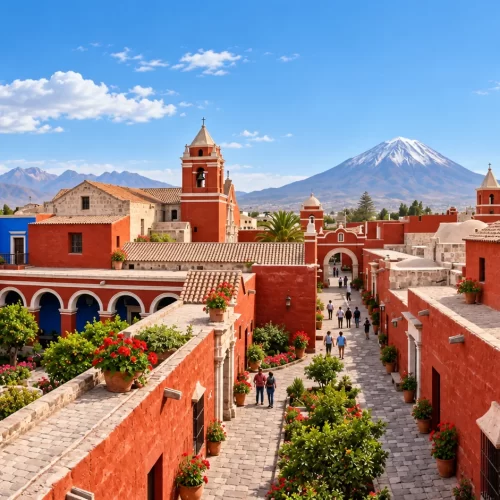
Hidden behind four centuries of silence and sun-bleached sillar stone, the Santa Catalina Monastery is one of the most extraordinary architectural wonders in the Americas. Step through its fortified gates in the heart of Arequipa and the modern world dissolves entirely. In its place: a self-contained city of labyrinthine cobblestone lanes, intensely pigmented cloisters washed in terracotta and indigo, gardens spilling with geraniums, and an eerie, magnificent stillness that no photograph has ever truly captured.
Founded in 1579, the monastery once housed up to 450 nuns and their servants within walls that enclosed 20,000 square meters — nearly an entire city block of what was then colonial Arequipa. Closed to the public for almost 400 years, it opened its doors in 1970 and has since emerged as one of Peru’s most visited and talked-about heritage sites. Yet despite the acclaim, the Santa Catalina Monastery Arequipa retains a genuine sense of timelessness and discovery that few historic sites in South America can match.
At Peruvian Luxe, we believe the monastery deserves more than a rushed group tour. Our private guided experiences at Santa Catalina reveal the human stories, the artistic treasures, and the architectural details that standard visits entirely miss — including exclusive access to areas rarely opened to the general public. A private visit here is not merely a museum tour; it is a journey into one of the most complex, most beautiful, and most haunting enclosed worlds ever built in the New World.
Planning a luxury visit to Arequipa? Contact Peruvian Luxe on WhatsApp and let us design your perfect Arequipa itinerary.
The History of Santa Catalina Monastery: A City Within a City
The story of Santa Catalina begins with an act of piety and privilege. In 1579, Maria de Guzman, a wealthy Arequipa widow, donated her fortune and her residence to the Dominican Third Order for the construction of a convent dedicated to Saint Catherine of Siena. Construction began in earnest on a grand scale — not merely a church and a few cloisters, but an entire self-contained religious complex designed to house, feed, educate, and spiritually sustain a community of cloistered nuns for eternity.
What emerged over the following century was nothing short of a miniature city. The complex grew to encompass streets, plazas, fountains, laundry areas, a cemetery, individual living cells, communal refectories, chapels, art galleries, and gardens. It was enclosed by walls nearly a meter thick, constructed entirely from volcanic sillar stone — the white-to-cream volcanic rock quarried from the slopes of El Misti that gives Arequipa its nickname, the White City.
Colonial Life Behind the Walls
Life inside the monastery was far from the austere existence one might imagine. During the 17th and 18th centuries, the wealthiest Spanish colonial families sent their daughters to Santa Catalina — not only for religious vocation, but as a mark of social prestige. Each nun’s cell was assigned according to her family’s status and financial contribution to the convent. The wealthiest nuns lived in spacious private apartments with their own kitchens, servants, gardens, and collections of fine art and silverware.
At its height, Santa Catalina housed up to 450 residents, including professed nuns, novices, servants, and slaves. The community maintained its own economy: nuns produced pastries, sweets, and embroideries sold to wealthy Arequipa families. They collected rents on properties throughout the city. They commissioned paintings from the finest masters of the Cusco School and imported ceramics and silverware from Spain and the Far East.
This comfortable, privileged existence was shattered in 1871 when Pope Pius IX ordered a radical reform of convents throughout Latin America. The new bishop of Arequipa expelled all servants and slaves, dismantled the nuns’ private economies, and imposed a strict rule of collective poverty. Many nuns departed in protest. The community that remained withdrew to the far northern section of the monastery, where a small community of Dominican nuns continues to live in strict enclosure to this day.
Opening to the World: 1970
For nearly four centuries, Santa Catalina remained entirely closed to the outside world — visible only as a silent island of whitewashed walls rising above Arequipa’s historic rooftops. In 1970, the monastery opened the majority of its complex to the public for the first time. What visitors discovered astonished them: an entire colonial city frozen in time, its streets deserted, its cells intact, its frescoes and paintings undisturbed, its courtyards still fragrant with geraniums and lavender.
Today, the monastery welcomes approximately 150,000 visitors per year and is considered one of Peru’s finest heritage sites — yet it remains, at its core, a living religious institution. The cloistered nuns occupy a restricted northern section that visitors may not enter, a reminder that behind the tourist experience lies a genuine, centuries-old community of prayer.
Architectural Highlights: A Walking Guide to Santa Catalina’s Walled World
The Santa Catalina Monastery Arequipa is best understood not as a single building, but as a series of distinct neighborhoods — each with its own character, color palette, and historical atmosphere. A thorough visit navigates the complex chronologically and spatially, moving from the grandest public spaces toward the increasingly intimate domestic quarters.
The Entrance Gate and Entrance Cloister
Entry to the monastery begins through a fortified gate on Calle Santa Catalina — a deliberately imposing threshold designed to mark the boundary between the secular city and the enclosed religious world within. Beyond it, a small lobby leads into the first great cloister, whose arcade of sillar arches frames a central garden fountain. The pale volcanic stone glows warmly even on overcast Arequipa days, and the transition from noisy street to this measured silence is genuinely startling.
The entrance cloister walls are lined with 17th and 18th-century religious paintings from the Cusco School — Peru’s distinctive colonial artistic tradition that blended European baroque technique with indigenous Andean iconography. Look for the characteristic flattening of perspective, the bold primary colors, and the incorporation of native Peruvian flora and fauna into biblical scenes.
The Novitiate Cloister
Immediately beyond the entrance lies the Novitiate Cloister, where young women who had entered the convent underwent their period of religious formation before taking permanent vows. The cloister features a double arcade of rounded sillar arches and a garden centered on a stone cross. The atmosphere here is deliberately austere compared to the richer cloisters of the professed nuns — a visual reminder of the distinction in status and comfort between novices and fully vowed sisters.
Calle Sevilla and the Colored Streets
The heart of Santa Catalina’s visual identity lies in its interior streets — and nowhere more dramatically than Calle Sevilla. This narrow cobblestone lane, barely two meters wide, is flanked by walls painted in a rich, saturated terracotta-orange on one side and a deep indigo-blue on the other. Geraniums in terracotta pots line every ledge. The interplay of volcanic stone, vivid pigment, and intense Andean light creates a scene of almost unreal beauty that has been reproduced in thousands of photographs — yet nothing fully prepares a visitor for the impact of experiencing it in person.
The colors used throughout the monastery — terracotta, ochre, cobalt, indigo — were not merely decorative. In the colonial era, colors were used systematically to distinguish different functional zones within the complex: areas for prayer, domestic work, contemplation, and recreation.
Plaza Zocodover and the Communal Fountain
The internal plaza known as Zocodover — named by the nuns after the famous square in Toledo, Spain — served as the social heart of the enclosed community. Here, nuns gathered after morning mass, novices received their formation, and the complex’s domestic rhythms played out across generations. A large stone fountain at the plaza’s center was the community’s primary water source, fed by the colonial aqueduct system that supplied all of Arequipa.
Adjacent to Zocodover is the monastery’s remarkable laundry area — a row of large terracotta pots set into a low stone wall, used for washing the community’s linens. The pots are stained with centuries of soap residue. Each one is labeled with the name of the nun it was assigned to — a small, intimate detail that brings the human scale of monastic life suddenly, movingly into focus.
The Professed Nuns’ Cells
The most revelatory section of any visit to Santa Catalina is the restored nuns’ private cells — individual domestic apartments that reveal the vast gap between the monastery’s collective identity and the private comfort of its wealthiest residents.
The most elaborately furnished cells feature:
- Private reception rooms with colonial furniture, mirrors, and personal art collections
- Small private kitchens with intact colonial ceramic stoves, cooking vessels, and storage jars
- Personal oratories (private prayer rooms) with individual altarpieces and silver devotional objects
- Sleeping quarters with original beds, embroidered linens, and personal devotional images
- Private garden terraces enclosed within the cell’s outer walls
The contrast between these comfortable, richly appointed private spaces and the collective austerity that reform eventually imposed is one of the monastery’s most compelling and historically revealing aspects.
The Main Church and Sacristy
Santa Catalina’s main church, facing the internal plaza, is a masterpiece of colonial sillar architecture. Its facade — carved in the dense, sculptural baroque style characteristic of Arequipa’s religious buildings — features elaborate stone reliefs of saints, angels, and floral motifs that demonstrate the extraordinary sophistication of local colonial artisans working in volcanic stone.
The interior retains its original gilded altarpiece and a substantial collection of colonial oil paintings. The sacristy, accessible on guided tours, houses the monastery’s silver collection — liturgical vessels, reliquaries, and processional crosses of remarkable quality that speak to the wealth that once flowed through these walls.
The Pinacoteca: An Art Gallery of Rare Quality
Santa Catalina’s Pinacoteca (art gallery) houses one of the finest collections of colonial religious paintings in southern Peru. The collection includes major works by Bernardo Bitti, the Italian Jesuit painter who transformed colonial Andean art in the late 16th century, alongside significant pieces from the Cusco School masters and anonymous indigenous artists whose work represents a uniquely syncretic tradition.
Key works to seek out include monumental canvas paintings of the Last Judgment, an exceptional series depicting the Life of Saint Catherine of Siena, and several portraits of colonial abbesses rendered with remarkable psychological intensity. Peruvian Luxe arranges private Pinacoteca sessions with specialist art historians who contextualize the collection within the broader history of colonial Andean visual culture.
The Colors of Santa Catalina: Understanding the Monastery’s Vivid Palette
No aspect of the Santa Catalina Monastery surprises first-time visitors more than its color. The popular imagination of a colonial convent conjures whitewashed austerity — bare stone, shadowed cloisters, silent corridors. Santa Catalina delivers none of that. Instead, the monastery’s walls blaze with some of the most vivid architectural pigmentation in Latin America: deep terracotta, saturated cobalt blue, warm ochre, dusty rose, and brilliant white, deployed in dramatic combinations that feel simultaneously ancient and startlingly modern.
The Source of the Colors
The monastery’s colors are not a modern restoration invention — though the 20th-century restoration process did intensify some of the original pigmentation for visual impact. The underlying color tradition is genuinely colonial. In 16th and 17th-century Spanish America, mineral-based pigments derived from local clays, volcanic minerals, and plant extracts were applied to plaster finishes on volcanic stone walls as both decoration and functional protection against moisture and weathering.
The terracotta orange that dominates Calle Sevilla is derived from iron oxide — the same mineral that gives the altiplano’s soil its characteristic red. The cobalt and indigo blues were historically more expensive, derived from imported mineral pigments or indigo plants, and their presence in quantity at Santa Catalina speaks to the convent’s considerable wealth during its colonial peak.
Color Zones Within the Monastery
- White zones — the entrance cloisters and novitiate areas, where the natural sillar stone was left uncolored or painted white, creating a deliberately austere and spiritually focused atmosphere
- Terracotta zones — the domestic streets and residential quarters, evoking warmth and earthiness in the community’s daily living spaces
- Blue zones — the prayer rooms, meditation corridors, and spaces associated with contemplation and the Virgin Mary, whose traditional color is the deep Marian blue visible throughout the chapel cloisters
- Ochre zones — transitional spaces, service areas, and storage rooms, where a warm golden-yellow pigment created a sense of productive, working space
Understanding this color coding transforms a walk through the monastery from an aesthetic experience into a reading of colonial monastic life — each corridor, each courtyard, each cell speaking its function through the language of pigment.
The Night Tour: Santa Catalina Monastery After Dark
One of Arequipa’s most extraordinary experiences — and one that Peruvian Luxe strongly recommends for all visitors — is the Santa Catalina Night Tour. On selected evenings, the monastery opens after sunset, and its corridors and cloisters are illuminated entirely by candlelight.
The effect is transformative. The colored walls, which glow warmly in daylight, take on an entirely different character in flickering candlelight — deepening to amber and burgundy in the terracotta zones, becoming almost otherworldly blue in the chapel corridors. The sounds of the city disappear. The monastery’s silence, already striking during the day, becomes absolute. Many visitors describe the night tour as one of the most genuinely moving cultural experiences of their lives in Peru.
Night tours run on Tuesday, Thursday, and Friday evenings from approximately 7:00 PM to 10:00 PM (schedule subject to seasonal variation). Booking is essential, as capacity is strictly limited. Peruvian Luxe arranges private night tour access with specialist evening guides for guests who wish to experience Santa Catalina in its most intimate and evocative incarnation.
Planning Your Private Visit to Santa Catalina Monastery
For the discerning traveler, a visit to Santa Catalina Monastery deserves careful planning. The complex is large — a self-guided visit without adequate time or a knowledgeable guide risks skimming the surface of a place that rewards deep, unhurried attention. Peruvian Luxe designs all Santa Catalina experiences as private, guided visits with specialist historians and art experts.
Practical Information at a Glance
| Detail | Information |
|---|---|
| Location | Calle Santa Catalina 301, Cercado, Arequipa — 5 minutes walk from Plaza de Armas |
| Day Visit Hours | Daily 9:00 AM – 5:00 PM (last entry 4:00 PM) |
| Night Tour Hours | Tuesday, Thursday, Friday: 7:00 PM – 10:00 PM (seasonal) |
| Recommended Duration | 2–3 hours (day); 1.5–2 hours (night tour) |
| Best Time to Visit | Early morning (9:00–11:00 AM) for fewest crowds; early evening for the golden hour light |
| Photography | Permitted throughout (no flash in Pinacoteca); tripods by special arrangement |
| Accessibility | Cobblestone surfaces throughout — not fully accessible for wheelchairs |
What to See in Limited Time
If your time in Arequipa is constrained, Peruvian Luxe recommends prioritizing these five highlights for a focused 90-minute visit:
- Calle Sevilla — the monastery’s iconic colored street; essential for photographs and architectural impact
- The Laundry Area (Lavanderia) — the most humanizing domestic detail in the entire complex
- A restored professed nun’s cell — to understand the reality of elite colonial monastic life
- The Pinacoteca — Santa Catalina’s finest colonial art collection
- The main church facade — a masterpiece of Arequipa baroque sillar carving
How Peruvian Luxe Elevates the Experience
A standard group visit to Santa Catalina — following a guide holding a numbered paddle through packed corridors — captures perhaps 20% of what this extraordinary place has to offer. Peruvian Luxe’s private visits are structured differently:
- Expert private guide — a specialist in Arequipa colonial history and Andean art history, providing context unavailable in any standard tour
- Early morning private access — entering before group tours begin, experiencing the monastery in near-total silence
- Pinacoteca private briefing — a dedicated session with a specialist on the painting collection
- Photography time — dedicated unpopulated photography sessions on Calle Sevilla and the main cloisters
- Night tour combination — pairing a morning visit with an evening candlelight return for a complete experience of the monastery across different atmospheric conditions
Santa Catalina and the Wider Arequipa Experience
The Santa Catalina Monastery sits at the heart of Arequipa’s historic center — itself one of the finest ensembles of colonial urban architecture in the Americas, recognized as a UNESCO World Heritage Site in 2000. A visit to Santa Catalina is best understood as the centerpiece of a broader Arequipa cultural immersion, not an isolated attraction.
Combining Santa Catalina with the Arequipa Historic Center
Within walking distance of Santa Catalina, Peruvian Luxe recommends:
- Plaza de Armas — Arequipa’s spectacular main square, framed by the twin-towered Cathedral and ringed by colonial arcades, is one of the finest plazas in South America. The Cathedral’s interior is exceptional, with a remarkable Flemish baroque organ.
- La Compania de Jesus Church — arguably the finest baroque facade in Peru, carved in such intricate detail that it resembles lace rather than stone. The adjacent cloisters now house high-end boutiques and a rooftop terrace restaurant.
- San Francisco Church and Cloister — a quieter, less-visited alternative with exceptional colonial paintings and a beautiful cloister garden
- The Yanahuara Viewpoint — a 15-minute drive from the center, this hilltop mirador frames a classic view of the city against the backdrop of El Misti, Chachani, and Pichu Pichu volcanoes — the definitive Arequipa panorama
Dining After the Monastery: Arequipa’s Picanterias
No visit to Arequipa is complete without experiencing the city’s celebrated picanteria tradition — the UNESCO-recognized culinary heritage of Arequipa’s traditional restaurants, which serve regional dishes that bear little resemblance to the Limeño food most international visitors associate with Peruvian cuisine.
Must-try dishes from the Arequipa table include:
- Rocoto relleno — a whole rocoto pepper stuffed with spiced minced meat, raisins, and egg, topped with melted cheese; the defining dish of Arequipa’s kitchen
- Adobo arequipeno — pork marinated overnight in chicha de jora and spices, slow-cooked until it falls from the bone; traditionally eaten for Sunday breakfast
- Cuy chactado — whole guinea pig fried under a stone weight until crisp; an ancient Andean delicacy with a surprisingly mild, gamey flavor
- Queso helado — Arequipa’s celebrated frozen dessert; a cylinder of sweetened, spiced rice milk ice cream that predates European-style ice cream in the region
Peruvian Luxe arranges private picanteria luncheons with advance menu consultation, allowing guests to experience the full depth of Arequipa’s culinary heritage in an unhurried, private setting.
Day Trips: The Colca Canyon and Surrounding Landscape
Arequipa serves as the gateway to the Colca Canyon — one of the world’s deepest canyons and home to the Andean condor, the largest flying bird on the planet. A luxury day trip or overnight stay in the Colca Valley is the natural complement to an Arequipa cultural experience, combining archaeological villages, thermal springs, and spectacular highland landscapes with world-class condor watching at Cruz del Condor viewpoint.
Peruvian Luxe designs integrated Arequipa and Colca experiences with private vehicles, premium lodges, and specialist naturalist guides — ensuring that both the cultural richness of the White City and the dramatic natural grandeur of the canyon are experienced at the depth they deserve.
Frequently Asked Questions: Santa Catalina Monastery Arequipa
What is the Santa Catalina Monastery in Arequipa?
The Santa Catalina Monastery is a 16th-century Dominican convent complex in the heart of Arequipa, Peru, recognized as one of the most extraordinary architectural heritage sites in the Americas. Founded in 1579 by wealthy widow Maria de Guzman, the monastery grew into a self-contained walled city of 20,000 square meters — with its own streets, plazas, churches, gardens, and domestic quarters. It housed up to 450 nuns and their servants at its peak. Opened to the public in 1970, it is celebrated for its vivid terracotta and indigo-painted cloisters, its labyrinthine cobblestone lanes, and its exceptional collection of colonial religious art. A small community of Dominican nuns continues to live in strict enclosure in the restricted northern section.
How long does a visit to Santa Catalina Monastery take?
A thorough visit to Santa Catalina Monastery takes between 2 and 3 hours for a standard guided experience. Peruvian Luxe recommends allowing 3 full hours for a private guided visit that covers the entrance cloisters, Calle Sevilla, the lavanderia, the professed nuns’ cells, the Pinacoteca art gallery, and the main church. Those combining a day visit with the evening night tour should plan for a total of 4-5 hours across both sessions. The complex is large and deserves unhurried attention — rushing through it significantly diminishes the experience.
What is the best time to visit the Santa Catalina Monastery?
The best time to visit is early morning, between 9:00 AM and 11:00 AM, when group tours have not yet arrived and the monastery can be experienced in relative silence. The quality of light in Arequipa is exceptional in the mornings — the high-altitude sun illuminates the colored walls with particular clarity. Late afternoon (3:00 PM – 5:00 PM) also offers beautiful light for photography. The night candlelit tour (Tuesday, Thursday, Friday evenings) offers a completely different and equally extraordinary atmospheric experience. Peruvian Luxe arranges early private access for guests seeking the monastery at its most serene.
What is the Santa Catalina night tour?
The Santa Catalina Night Tour is an evening visit conducted by candlelight, offered on selected evenings (typically Tuesday, Thursday, and Friday from approximately 7:00 PM to 10:00 PM, though schedules vary seasonally). The monastery is illuminated exclusively by candles placed throughout the corridors and cloisters, transforming the colored walls into a profoundly atmospheric, almost theatrical experience. Many visitors rank the night tour among the most memorable cultural experiences of their time in Peru. Booking is essential as capacity is strictly limited. Peruvian Luxe arranges private night tour access with specialist evening guides.
Is the Santa Catalina Monastery still an active convent?
Yes — Santa Catalina Monastery remains an active Dominican convent. A small community of cloistered nuns continues to live in strict religious enclosure in the restricted northern section of the complex, which is entirely closed to visitors. The nuns’ lives, their daily schedule of prayer, and their cloistered community exist simultaneously with the public heritage site — a fact that adds a profound dimension of living continuity to what might otherwise feel like a purely historical museum experience.
What is Calle Sevilla and why is it famous?
Calle Sevilla is the most celebrated interior street of the Santa Catalina Monastery — a narrow cobblestone lane flanked by walls painted in deep terracotta-orange on one side and vivid indigo-blue on the other, lined with geranium-filled terracotta pots. Named by the nuns after the famous street in Seville, Spain, it is the monastery’s most photographed location and the image most associated with Santa Catalina internationally. The combination of vivid Andean pigmentation, colonial stone, and intense high-altitude light creates a visual impact that no photograph fully conveys. Peruvian Luxe arranges dedicated photography time on Calle Sevilla before group tours arrive.
What art collection does Santa Catalina Monastery hold?
Santa Catalina’s Pinacoteca houses one of the finest collections of colonial religious paintings in southern Peru. The collection includes significant works by Bernardo Bitti — the Italian Jesuit master who transformed colonial Andean painting in the late 16th century — alongside important works from the Cusco School tradition and anonymous indigenous masters. Highlights include monumental Last Judgment canvases, a Life of Saint Catherine series, and psychologically compelling portraits of colonial abbesses. Peruvian Luxe arranges private Pinacoteca sessions with specialist art historians for guests seeking a deeper engagement with the collection.
How do I get to the Santa Catalina Monastery from Arequipa's Plaza de Armas?
The Santa Catalina Monastery is located on Calle Santa Catalina 301 in the Cercado district — approximately a 5-minute walk from Arequipa’s Plaza de Armas. The route is straightforward along pedestrianized or low-traffic colonial streets. Alternatively, the short journey can be made by taxi in under 5 minutes. Peruvian Luxe includes chauffeured transfers to and from the monastery as part of all private Arequipa touring programs, eliminating any navigation concern and ensuring seamless arrival at the recommended early morning entry time.
Can I photograph inside the Santa Catalina Monastery?
Photography is freely permitted throughout the Santa Catalina Monastery, including in the living quarters, streets, and gardens. Flash photography is restricted in the Pinacoteca art gallery to protect the colonial canvases. Tripods may be arranged by special permission. The monastery is one of Peru’s most rewarding photography destinations — Calle Sevilla, the laundry area, the main church facade, and the garden cloisters are all exceptional subjects. Peruvian Luxe arranges dedicated photography windows during early morning private access, when the monastery’s most celebrated locations are free of crowds.
How does Peruvian Luxe enhance the Santa Catalina Monastery experience?
Peruvian Luxe transforms the standard monastery visit into a genuinely immersive cultural experience. Our private Santa Catalina programs include: specialist colonial history and art history guides; early morning private access before group tours begin; dedicated Pinacoteca art sessions; photography time on Calle Sevilla and the main cloisters; optional night tour combination; and seamless integration with the wider Arequipa itinerary including picanteria dining, historic center walking tours, and Colca Canyon day trips. Contact Peruvian Luxe via WhatsApp to design your perfect Arequipa program.
Experience the Santa Catalina Monastery with Peruvian Luxe
The Santa Catalina Monastery is not merely a heritage site — it is one of the most layered, most beautiful, and most emotionally resonant places in all of South America. Its colored streets, its intact colonial domestic world, its extraordinary art collection, and the haunting awareness of a living cloistered community still within its walls combine to create an experience that goes far beyond conventional sightseeing. But experiencing it fully requires time, context, and expert guidance that only a private visit can provide.
At Peruvian Luxe, we design Arequipa itineraries that place the Santa Catalina Monastery at their cultural heart — surrounded by the city’s finest architecture, its exceptional cuisine, and the dramatic natural beauty of the surrounding volcanic landscape and Colca Canyon. Every detail is handled: private guides with genuine specialist expertise, early access arrangements, photography time, restaurant reservations, and seamless chauffeured logistics throughout.
Arequipa deserves more than a hurried stopover. Contact Peruvian Luxe on WhatsApp today and let us create the Arequipa experience you will carry with you for the rest of your life.