Contact us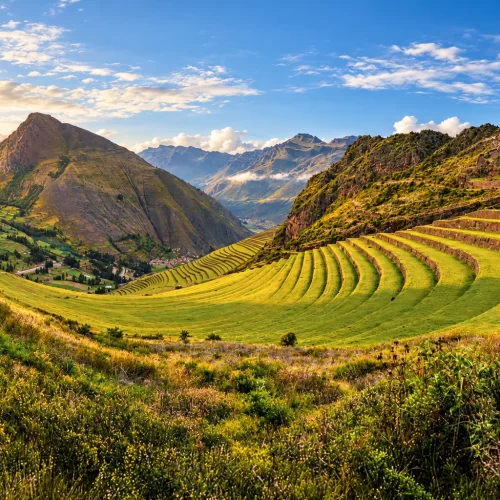
Thirty-two kilometers northeast of Cusco, where the Urubamba River begins its descent through the Sacred Valley and the mountains rear up in a green amphitheater of terraced stone, lies Pisac—one of the most complete and visually magnificent of all Inca archaeological complexes. Above the town, carved into a soaring mountain ridge, the ruins of Pisac command views that encompass the entire valley in a panorama that would have been deliberate: the Inca Empire understood the political and spiritual power of altitude, and Pisac was designed to be seen and to see everything.
Below, in the cobbled streets of the town at the valley floor, one of the most celebrated artisan markets in all of South America unfolds beneath the Andean sky. On the best market days—particularly Sunday mornings—Quechua community members from the surrounding highland villages descend to Pisac in traditional dress to sell textiles, ceramics, silver jewelry, and produce that speak of continuous traditions stretching back centuries before the arrival of the Inca themselves.
A day in Pisac, properly planned and privately guided, is not merely a day trip. It is a full immersion into the intellectual achievement of Inca civilization, the living culture of the Andean highlands, and the extraordinary natural beauty of the Sacred Valley. For the discerning traveler staying in Cusco, it represents one of the most rewarding single-day experiences in all of Peru. The team at Peruvian Luxe specializes in designing private, unhurried Pisac experiences that allow you to go deeper than any group tour can reach.
Ready to experience Pisac exactly the way you want to? Contact Peruvian Luxe on WhatsApp and let us design your private Sacred Valley day journey.
Pisac at a Glance: Essential Facts for the Discerning Traveler
| Detail | Information |
|---|---|
| Distance from Cusco | Approx. 32–34 km (19–21 miles) by road |
| Drive time from Cusco | 45–75 minutes (private vehicle, road conditions permitting) |
| Pisac town elevation | Approx. 2,950–2,972 m (9,678–9,751 ft) above sea level |
| Pisac ruins elevation | Up to approx. 3,500 m (11,483 ft) at the highest sectors |
| Ruins opening hours | Daily 7:00 a.m. – 6:00 p.m. |
| Entrance ticket | Boleto Turistico del Cusco (approx. 130 Soles full circuit) — no individual ticket available |
| Best market days | Sunday (largest, most vibrant); also Tuesday and Thursday |
| Recommended visit duration | Full day (ruins: 2–3 hours; market: 1–2 hours; lunch: 1.5–2 hours) |
| Acclimatization advantage | Pisac town is lower than Cusco — ideal as an early acclimatization destination |
| Luxury transport recommended | Private chauffeured vehicle with bilingual expert guide |
The Pisac Archaeological Site: A Complete Guide to the Inca Complex
The Pisac archaeological complex is one of the largest and best-preserved Inca sites in Peru—surpassing many more widely visited sites in scale, architectural diversity, and agricultural engineering. It was likely established in the 15th century under the Inca Emperor Pachacutec and served simultaneously as a royal estate, a religious sanctuary, a military garrison, and an agricultural production center of extraordinary sophistication. Understanding the site’s different sectors is essential to appreciating the full scope of what was built here.
The Agricultural Terraces: A Masterpiece of Andean Engineering
The most visually iconic feature of Pisac—the vast system of agricultural terraces (andenes) sweeping across the mountainside in great curving arcs—is also the most immediately comprehensible achievement of Inca engineering. These terraces were not merely practical; they were a statement of civilization’s mastery over one of the world’s most challenging agricultural environments.
Each terrace was carefully engineered with a drainage system and infilled with topsoil transported from lower elevations to create a series of micro-climates that allowed cultivation at multiple altitudes simultaneously. Lower terraces grew corn (maíz), the sacred crop of the Inca, while higher terraces supported quinoa, potatoes, and cold-weather tubers. The terracing also served to prevent erosion on the steep mountainsides—a function that is still visually evident today, with many sections of the original andenes actively maintained.
The Intihuatana: Sacred Temple and Astronomical Center
At the heart of the upper archaeological complex lies the Intihuatana sector—the ceremonial and religious center of Pisac and, for most visitors, the most architecturally breathtaking part of the site. The name translates from Quechua as “Hitching Post of the Sun,” a reference to the carved stone gnomon that functioned as an astronomical instrument, allowing Inca priests and astronomers to track the movement of the sun through the year and determine the sacred calendar.
The Intihuatana sector includes the main temple complex, royal residential chambers, ceremonial baths fed by Inca-engineered water channels that still flow today, and some of the most refined examples of Inca stone masonry anywhere in the Sacred Valley. The seamless fitting of massive stone blocks without mortar—in some cases with seventeen-sided stones that fit with millimeter precision—continues to resist straightforward explanation by modern engineers. The views from this sector are extraordinary: on clear mornings, the entire Sacred Valley unfolds below in a panorama of green fields, terraces, and the silver ribbon of the Urubamba River.
K’alla Q’asa: The Military Sector
On the highest and most exposed ridgeline of the complex sits K’alla Q’asa—the military garrison sector of Pisac, positioned to monitor all approaches to the Sacred Valley from the south. This sector features simpler, more functional architecture designed for practicality rather than ceremony: guardhouses, storage structures (qollqas), and watchtowers placed to offer unobstructed sightlines across the valley and the mountain passes above. For hikers willing to push to the highest points of the complex, the views from K’alla Q’asa are arguably the most sweeping of any accessible viewpoint in the entire Sacred Valley.
Qantus Raqay: Residential Quarters
The Qantus Raqay sector, situated near the main upper entrance to the complex, represents the residential quarter of the ancient settlement—the area where the non-royal population of the estate lived and worked. The architecture here is less refined than the ceremonial center but no less interesting: compact stone buildings, communal spaces, and distinctive trapezoidal niches in the walls that were used for storage and ritual display. This sector offers valuable context for understanding Pisac not merely as a royal monument but as a functioning community of thousands of people.
The Cliff Tombs: Sacred Rest Above the Valley
Visible from the access road below and from several viewpoints within the complex, the ancient cliff tombs (chullpas) of Pisac are carved directly into the vertical rock face of the gorge opposite the main ruins—a location chosen deliberately to place the dead as close to the sky as possible, in accordance with Andean cosmological beliefs about the relationship between the living and the ancestral world. The tombs were largely looted during the colonial period and are not accessible to visitors, but they remain one of the most haunting visual elements of the Pisac experience, visible as dark openings in the sheer cliff face.
The Pisac Artisan Market: How to Navigate It Like a Connoisseur
The Pisac artisan market is one of the most celebrated in South America—and one of the most misunderstood. At its best, it is a genuine gathering of Andean artisans and highland community members, with extraordinary textiles, handmade ceramics, silver jewelry, and agricultural products that reflect the living culture of the surrounding mountains. At its most tourist-oriented, it can feel overwhelming and indistinguishable from any other Peruvian souvenir market. Knowing how to navigate it makes all the difference.
Best Days to Visit
- Sunday: The largest and most vibrant market day, when Quechua community members from surrounding highland villages descend to Pisac in traditional dress to sell their goods and produce. Sunday mornings also feature a traditional mass held in Quechua at the local San Pedro church—a culturally significant event that takes place before the market reaches full intensity. The trade-off is crowds: expect tour buses, more tourist-oriented vendors, and a more commercially oriented atmosphere in the main sections.
- Tuesday and Thursday: Smaller markets that offer a more intimate shopping experience. With significantly fewer tourists, you can take more time with individual artisans, engage in genuine conversation about their craft and materials, and shop without the pressure of crowds. For the discerning traveler who prioritizes quality interaction over volume of choice, a Tuesday or Thursday visit is often the superior experience.
- Weekday mornings: Even outside of the main market days, a morning visit to Pisac town will find local vendors in the plaza with textiles, ceramics, and food. The atmosphere is quieter and the prices tend to be more honest.
What to Look For
- Textiles: Pisac market is strongest for alpaca and wool textiles—shawls, ponchos, blankets, and scarves. Look for natural-dye color palettes (earthy reds, blues, yellows, and tans) and the subtle irregularities of hand-weaving. Seek out vendors from the surrounding communities who are wearing their own traditional dress—they are most likely selling their own work.
- Silver jewelry: Pisac has a strong tradition of silver work incorporating semi-precious Andean stones—turquoise, sodalite, and Peruvian pink opal. Look for the 925 hallmark (sterling silver) on any jewelry purchase and ask artisans about their sourcing of stones and techniques.
- Ceramics: Regional pottery in traditional Andean forms, often hand-painted with geometric and zoomorphic patterns. Quality varies significantly between vendors; pieces that appear too perfect and uniformly painted are likely commercially produced.
- Clay oven-baked empanadas: A Pisac institution. The local women who bake these in traditional wood-fired clay ovens near the market are among the most authentic vendors in the entire plaza—and the empanadas are excellent by any measure.
Shopping Strategy for the Luxury Traveler
Rather than attempting to cover the entire market, focus your time on the vendors who can engage in genuine conversation about their craft—with your guide translating as needed. Pisac Luxe recommends focusing on two or three specific item categories, identifying the highest-quality vendor for each, and making deliberate purchases rather than browsing impulsively across hundreds of identical stalls. Bring cash in small-denomination Soles; the vast majority of market vendors do not accept credit cards. A reasonable price negotiation is culturally appropriate and expected, but resist the impulse to bargain aggressively—these items represent the artisan’s livelihood and skilled labor.
The Perfect Luxury Day Trip Itinerary: Cusco to Pisac
For the discerning traveler, the ideal Pisac day trip combines early ruins access (before the tour buses arrive), a private gourmet lunch in the Sacred Valley, and a focused, unhurried afternoon at the market. Here is the sequence that Peruvian Luxe recommends for a full-day private experience.
7:00 a.m. — Private Departure from Cusco
Your private chauffeured vehicle departs from your hotel in Cusco at 7:00 a.m., allowing you to reach Pisac before the first wave of group tours. The drive follows the Cusco-Pisac road through the Andean outskirts of the city, climbing briefly before descending into the Sacred Valley. A knowledgeable guide will provide context on the landscape, the communities visible from the road, and the agricultural transformation of the valley that you are entering. Cusco sits at approximately 3,399 meters; Pisac town at approximately 2,970 meters—the descent itself is a mild form of acclimatization that many travelers find relieves altitude-related discomfort.
8:00–11:00 a.m. — Pisac Archaeological Site (Private Access)
Early arrival at the ruins is the single most important logistical decision of the day. The site opens at 7:00 a.m. and the first tour buses typically arrive between 9:30 and 10:00 a.m. A private arrival between 8:00 and 8:30 a.m. gives you up to two hours of essentially private access to one of the most extraordinary Inca sites in the Sacred Valley.
Your expert guide will lead you through the main sectors in a logical sequence—beginning with the Intihuatana ceremonial center (the most architecturally refined and highest-altitude sector), moving through the agricultural terraces, and descending through Qantus Raqay before reaching the valley road. Many visitors choose to take a private vehicle to the upper entrance and hike down through the ruins on the descending trail—a 1.5 to 2-hour descent that passes through all major sectors and offers continuous views of the valley below. This “descending circuit” is universally preferred over the reverse because it maximizes your time in the most spectacular upper sections before fatigue sets in.
The Boleto Turistico del Cusco (full circuit ticket, approximately 130 Soles) is required for entry. Peruvian Luxe coordinates ticket logistics as part of your private day itinerary.
11:30 a.m. — Private Gourmet Lunch in the Sacred Valley
After the ruins, your private vehicle drives to your pre-arranged lunch reservation in the Sacred Valley. Several exceptional options exist at varying distances from Pisac:
- Cuchara de Palo (Pisac): Located in the historic Pisac Inn in the town itself, this restaurant is known for its rustic charm, innovative use of organic locally sourced Andean ingredients, and farm-to-table ethos. The most convenient option if you prefer to lunch in Pisac before the market.
- Huacatay (Urubamba): One of the Sacred Valley’s most celebrated upscale restaurants, set in a beautiful garden environment in Urubamba. Frequently praised for its creative menu fusing contemporary cooking with Andean ingredients. Pre-booking essential during high season.
- Wayra at Sol y Luna (Urubamba): A sophisticated restaurant within the premium Sol y Luna hotel, known for its elegant interpretations of traditional Andean cuisine including Pachamanca preparations. The garden setting is among the most beautiful of any restaurant in the valley.
- MIL Centro (near Moray): The pinnacle of Sacred Valley dining, this restaurant by Virgilio Martinez (of Central, repeatedly ranked among the world’s best restaurants) offers an immersive 8-course tasting menu exploring altitude-specific Andean ingredients. Advance reservations are required weeks or months ahead. A 40-minute drive from Pisac, it is best combined with a visit to the nearby Moray and Maras Salt Mines.
1:30–3:30 p.m. — Pisac Artisan Market
The afternoon—after the tour bus crowds have begun to thin—is an excellent time for a focused, unhurried exploration of the Pisac artisan market. With the physical exertion of the ruins complete and lunch accomplished, you can give your full attention to the market’s finest vendors. Your guide will help you identify the most authentic stalls, facilitate genuine conversation with artisans, assist with any language barriers, and provide context on the cultural significance of specific textile patterns, ceramic traditions, or jewelry techniques you encounter.
4:00 p.m. — Return to Cusco
Your private vehicle returns you to your Cusco hotel by late afternoon, ideally in time for a sunset view from one of the city’s rooftop bars or historic viewpoints before dinner.
Practical Information: Everything You Need to Know Before You Go
The Boleto Turistico del Cusco
Entry to the Pisac archaeological site requires the Boleto Turistico del Cusco—there is no individual ticket available for Pisac alone. The full circuit ticket (approximately 130 Soles, valid for 10 days) grants access to Pisac and numerous other sites throughout the Cusco region including Ollantaytambo, Moray, Chinchero, Tipon, and several museums in Cusco city. A partial circuit ticket covering only sites in the Sacred Valley is also available at a lower price. Your Peruvian Luxe concierge team will advise on the most cost-effective ticket option based on your full itinerary.
What to Wear and Bring
- Layered clothing: Mornings in the Sacred Valley can be cool, particularly at the upper ruins sectors above 3,400 meters. Afternoons warm considerably. The Peruvian Luxe layering approach—a quality merino or alpaca base layer, a mid-layer, and a wind/rain shell—is ideal for variable Andean conditions.
- Sun protection: At this altitude, UV radiation is significantly more intense than at sea level. High-SPF sunscreen, UV-protective sunglasses, and a wide-brimmed hat are essential, particularly for the exposed sections of the ruins.
- Comfortable walking shoes: The descending ruins circuit involves uneven stone steps and moderate slopes. Quality trail shoes or walking boots with ankle support are strongly recommended over sandals or casual footwear.
- Cash in Soles: For market purchases. Small denominations (10, 20, and 50 Soles notes) are most practical. Most market vendors do not accept credit cards or US dollars.
- Water and snacks: Though your private itinerary includes a gourmet lunch, bring water for the ruins circuit. Altitude dehydration is a real concern, and staying hydrated significantly reduces any altitude-related discomfort.
Altitude Considerations
Pisac town (2,970 m) is meaningfully lower than Cusco (3,399 m), which is why a Sacred Valley day trip is often recommended as one of the first excursions after arrival in Cusco—the lower altitude can help travelers who are still acclimatizing. However, the upper sectors of the Pisac ruins rise to approximately 3,500 meters, so the exertion of hiking in the complex should be paced carefully. Move slowly, breathe deeply, drink plenty of water, and listen to your body. Your Peruvian Luxe guide will set an appropriate pace and will always have altitude medication available.
Photography Tips
The Pisac ruins are most photogenic in the early morning hours (7:00–9:30 a.m.) when the angled light illuminates the terraces dramatically and the mist sometimes lingers in the valley below. The Intihuatana sector offers the most architecturally spectacular shots, while the descending trail through the terraces provides the widest panoramic opportunities. In the market, always ask permission before photographing individuals—particularly elders in traditional dress—and offer a small tip (1–2 Soles) as a gesture of respect.
How to Combine Pisac with Other Sacred Valley Highlights
Pisac pairs naturally with several other Sacred Valley destinations as part of an extended day trip or overnight itinerary:
- Maras Salt Mines and Moray (30–45 minutes from Pisac): The ancient salineras of Maras—thousands of terraced salt evaporation ponds still harvested by the local community—and the mysterious circular agricultural terraces of Moray make a natural complement to Pisac on a full Sacred Valley day. If adding MIL Centro for lunch, this combination is the logical full-day Sacred Valley circuit.
- Chinchero (20 minutes from Pisac): The highland weaving village of Chinchero can be combined with a Pisac morning as an early afternoon stop, particularly on days when the cooperative demonstrations are running. This combination allows you to first see authentic market textiles in Pisac, then witness their creation process in Chinchero.
- Ollantaytambo (1 hour from Pisac): If combining with Ollantaytambo, plan for an overnight in the Sacred Valley rather than attempting the entire circuit as a single day trip from Cusco. The Peruvian Luxe team can arrange accommodation at luxury lodges in the Sacred Valley that make this extended itinerary exceptionally comfortable.
Frequently Asked Questions: Pisac Day Trip from Cusco
How far is Pisac from Cusco and how long does the drive take?
Pisac is approximately 32–34 kilometers (19–21 miles) from Cusco by road. In a private chauffeured vehicle, the drive typically takes 45–75 minutes depending on traffic and road conditions. The route descends from Cusco’s altitude of approximately 3,399 meters to Pisac town at approximately 2,970 meters, making it a pleasant and naturally acclimatizing journey through the Andean foothills and Sacred Valley landscape.
What is the best day to visit the Pisac artisan market?
Sunday is the largest and most famous market day, when Quechua community members from surrounding highland villages come to Pisac in traditional dress. It is also the most crowded, with more tour buses and a more tourist-oriented atmosphere in the main stalls. For a more intimate experience with greater access to genuine artisans and less crowd pressure, Tuesday and Thursday markets are excellent alternatives. For the luxury traveler who values quality over quantity, a weekday visit with a private guide focused on specific artisan categories can be more rewarding than a crowded Sunday market.
Do I need the Boleto Turistico to visit the Pisac ruins?
Yes. Entry to the Pisac archaeological site requires the Boleto Turistico del Cusco—there is no individual ticket available for Pisac alone. The full circuit ticket (approximately 130 Soles) is valid for 10 days and includes access to Pisac and many other regional sites including Ollantaytambo, Moray, and Chinchero. A partial Sacred Valley circuit ticket is also available at a lower price. Your Peruvian Luxe concierge will advise on the best option for your complete itinerary.
What are the main sectors of the Pisac archaeological site?
The Pisac complex is divided into several distinct zones: the Intihuatana (ceremonial center with temples, royal residences, and the astronomical Intihuatana stone); the agricultural terraces (andenes) sweeping across the mountainside; K’alla Q’asa (the military sector on the highest ridge); Qantus Raqay (residential quarters); and the cliff tombs (chullpas) carved into the rock face above the gorge. The site was likely established in the 15th century under Emperor Pachacutec and functioned simultaneously as a royal estate, religious sanctuary, military garrison, and agricultural production center.
Is it better to hike up or down through the Pisac ruins?
Most visitors and guides strongly recommend taking a private vehicle or taxi to the upper entrance and hiking down through the ruins toward the valley floor. This approach maximizes your time in the most spectacular upper sectors—particularly the Intihuatana ceremonial center—before fatigue sets in, and the descending trail is significantly less strenuous than climbing from the valley floor. The descent through all major sectors takes approximately 1.5 to 2 hours at a comfortable pace with time for photography.
What are the best luxury lunch options near Pisac in the Sacred Valley?
Several excellent options exist at varying distances from Pisac. In Pisac town itself, Cuchara de Palo (at the Pisac Inn) offers farm-to-table Andean cuisine in a charming rustic setting. In Urubamba (30–40 minutes away), Huacatay and Wayra at Sol y Luna are among the valley’s most celebrated upscale restaurants. For the pinnacle dining experience, MIL Centro near Moray—by chef Virgilio Martinez—offers an 8-course tasting menu exploring altitude-specific Andean ingredients; advance reservations are required weeks ahead and the restaurant is typically combined with a visit to Moray and Maras.
What should I wear and bring for a day trip to Pisac?
Pack for variable conditions: the Sacred Valley mornings can be cool (especially in the upper ruins sectors above 3,400 m) while afternoons warm considerably. Essential items: layered clothing (merino or alpaca base layer, mid-layer, wind/rain shell); high-SPF sunscreen; UV-protective sunglasses; a wide-brimmed hat; comfortable walking shoes or trail boots with ankle support (the ruins circuit involves uneven stone steps); water and snacks for the ruins; and cash in small-denomination Soles for market purchases (most vendors do not accept cards).
Is Pisac suitable for travelers still acclimatizing to altitude?
Yes—Pisac town (2,970 m) is meaningfully lower than Cusco (3,399 m), which is why a Sacred Valley day trip is often recommended as one of the first excursions after arriving in Cusco. The lower altitude at the valley floor can provide relief from altitude-related symptoms. However, the upper sectors of the Pisac ruins rise to approximately 3,500 m, so pace yourself during the ruins circuit, stay hydrated, and take breaks as needed. Your Peruvian Luxe guide will monitor your condition and set an appropriate pace throughout the day.
Can I visit Pisac and other Sacred Valley sites on the same day?
Yes, Pisac combines naturally with several other Sacred Valley sites as part of an extended day trip. Maras Salt Mines and Moray are 30–45 minutes from Pisac and pair well with a MIL Centro lunch for a complete western Sacred Valley circuit. Chinchero (20 minutes) can be added as an afternoon stop for a weaving demonstration and textile shopping. Ollantaytambo is best experienced as part of an overnight itinerary in the Sacred Valley rather than rushed as part of a single Cusco day trip.
How can Peruvian Luxe enhance my Pisac day trip experience?
Peruvian Luxe designs fully private Pisac experiences that go far beyond what a standard group tour can offer. We provide expert bilingual guides with deep knowledge of Inca history and archaeology, private chauffeured vehicles with hotel pickup and drop-off, pre-arranged gourmet lunch reservations at the valley’s finest restaurants, focused artisan market visits with guide-facilitated artisan introductions, and complete Boleto Turistico coordination. We can also arrange private weaving demonstrations in Chinchero, visits to the CTTC in Cusco, and extended Sacred Valley overnight itineraries at luxury lodges. Contact us via WhatsApp to design your ideal day.
What is the Intihuatana stone at Pisac and why is it significant?
The Intihuatana is a carved stone gnomon—a precisely shaped stone outcrop—that functioned as an astronomical instrument for Inca priests and astronomers. The name translates from Quechua as “Hitching Post of the Sun.” By observing the shadows cast by the Intihuatana at different times of day and different seasons, Inca priests could determine the position of the sun in the ritual calendar, predict solstices and equinoxes, and time agricultural and religious activities accordingly. The Intihuatana at Pisac is located at the heart of the ceremonial temple complex and is one of the most significant examples of Inca astronomical architecture in the Sacred Valley.
Experience Pisac the Way It Deserves to Be Experienced
The Pisac that most travelers glimpse from a group tour bus window—fifteen minutes at the market, forty minutes at the ruins, a buffet lunch in Urubamba—is a shadow of what this place actually is. The Pisac that reveals itself to a private, unhurried visitor in the early morning light, moving at their own pace through 15th-century stone architecture with an expert guide and the entire valley spread below, is one of the most extraordinary experiences available anywhere in the Andean world.
At Peruvian Luxe, we design Pisac days that give you both versions of this extraordinary place: the archaeological genius of the ruins and the living cultural vitality of the market, connected by a gourmet lunch and experienced from the comfort of a private vehicle with guides who know these sites with the depth that only genuine local expertise provides.
Design your perfect Pisac day trip with Peruvian Luxe. Reach out to our team on WhatsApp and let us create an experience as remarkable as the destination itself.