Contact us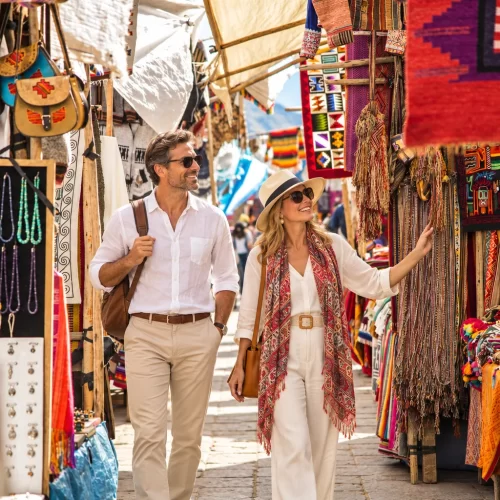
There is a moment that many thoughtful travelers experience in Peru—standing in a Cusco market, holding a beautifully woven textile, wondering: who made this? Was it the woman smiling across the stall, or a factory in a distant city? Does my purchase reach the artisan, or disappear into a chain of intermediaries? These questions matter deeply, because Peru is one of the world’s most extraordinary living repositories of artisan culture—a country where backstrap-loom weaving, hand-thrown ceramics, colonial silver smithing, and natural-dye traditions have been practiced continuously for thousands of years and are still practiced today by communities across the Andes.
The difference between a souvenir that funds a family in the Sacred Valley and one that funds a synthetic import operation can be invisible to the eye. And with Peru’s extraordinary cultural wealth comes an equally extraordinary volume of imitation—mass-produced goods that wear the aesthetic of Andean craft without any of its substance, soul, or economic benefit to the communities whose heritage they mimic.
This guide is for the traveler who wants to do more than take home a beautiful object. It is for those who want their purchase to be an act of connection—with the weaver, the potter, the silversmith, the dye-maker—and with the living cultures that make Peru one of the most compelling destinations on earth. When you are ready to explore Peru with a team that knows which cooperatives, workshops, and boutiques deserve your trust, Peruvian Luxe is here to guide every step of the journey.
Want a curated ethical shopping experience built into your luxury Peru itinerary? Contact Peruvian Luxe on WhatsApp and let us connect you with the artisans and cooperatives that deserve to be found.
Why Ethical Shopping in Peru Matters More Than You Think
Peru’s artisan economy is vast, complex, and often invisible to the casual traveler. The country is home to over one million artisans, and handicrafts represent the second-largest source of employment after agriculture in the Andean highlands. Yet the economic benefits of souvenir tourism are not automatically distributed equitably. When mass-produced goods—often manufactured far from Peru or imported from neighboring countries—fill market stalls under labels claiming local origin, the artisan communities whose cultural heritage attracts visitors in the first place receive nothing.
The stakes extend beyond economics. Many of the most endangered artisan traditions in Peru—natural indigo dyeing, pre-Columbian ceramic forms, colonial-era silver filigree, and the highly specific regional textile patterns that identify a weaver’s community of origin—survive only because there is a market for them. When travelers choose cheaper synthetic imitations, they are not merely missing out on quality; they are, unknowingly, participating in the erosion of practices that have no written instruction manual and cannot be recovered once the last practitioners are gone.
Ethical shopping in Peru is therefore not a niche concern for activists. It is the single most direct way a luxury traveler can translate their presence in a country into something lasting and genuinely beneficial—far more so than any donation to a distant charity.
The Five Principles of Ethical Souvenir Shopping in Peru
Before exploring specific destinations and products, internalizing these five principles will guide every purchase decision you make in Peru.
1. Buy Direct — Eliminate the Intermediary
The most transformative shopping decision you can make in Peru is to buy as close to the maker as possible. When you purchase from an artisan at their workshop, from a weaver’s cooperative that the artisan belongs to, or from a non-profit that lists its artisan partners by name, the economic benefit of your purchase is maximized. Every layer of intermediary between maker and buyer—market stall owner, wholesaler, export agent, hotel boutique—reduces the percentage that reaches the artisan’s hands.
2. Pay a Fair Price — Reject the Race to the Bottom
Aggressive bargaining for the lowest possible price in artisan markets is one of the most harmful behaviors a well-intentioned traveler can engage in. A beautifully hand-woven textile that took a weaver three days to complete cannot ethically be priced at ten dollars. Fair trade pricing reflects the actual cost of skilled labor, quality materials, and sustainable production. If a price seems impossibly low for the quality of what you are holding, it is because something in the chain—almost always the artisan’s wage—has been compressed to make it so.
3. Ask Meaningful Questions
Authentic artisans and ethical retailers welcome questions about their products. Ask: Who made this? Where were the materials sourced? How long did it take to make? What technique or tradition does this represent? True craftspeople are almost universally eager to share the story behind their work. Vendors who cannot answer these questions—or who give evasive, vague responses—are likely selling mass-produced goods regardless of their labels.
4. Embrace Imperfection as Authenticity
Machine-made and factory-produced imitations of Andean crafts are often eerily perfect—uniform color distribution, identical dimensions, flawlessly regular patterns. Genuine handmade textiles woven on backstrap looms, hand-thrown ceramic pieces, and hand-beaten silver jewelry will almost always feature subtle variations in their pattern, slight asymmetries, individual color gradients, and the unique marks of human hands. These imperfections are not flaws—they are the signatures of the artisan, and they are what make each piece genuinely one-of-a-kind.
5. Understand What You Cannot Take Home
Ethical shopping also means knowing the boundaries of what can and cannot be exported from Peru. Some of the most compelling objects in Peruvian markets are restricted or prohibited under Peruvian law and international treaties. Purchasing them—regardless of how compelling they appear—makes you complicit in their removal from Peru’s cultural and ecological patrimony.
What You Cannot Legally Take Out of Peru: The Essential Export Rules
Before exploring where to shop, every traveler should understand what cannot or should not be purchased as a souvenir in Peru. Ignorance of these rules is not a legal defense, and violations can result in confiscation, fines, and serious legal consequences.
Pre-Hispanic and Colonial Artifacts
It is strictly illegal under Peruvian law (Ley 28296, General Law of Cultural Heritage) to export original pre-Hispanic, Colonial, or early Republican artifacts—including ancient pottery, textiles, stone carvings, metal objects, or fossils. Any object that appears genuinely old should be treated with extreme caution. If you wish to purchase a replica of a pre-Hispanic or colonial object (a common and perfectly legal souvenir), you must obtain a Certificate of Export of Goods Not Listed as National Cultural Patrimony from Peru’s Ministry of Culture. Reputable sellers of quality replicas will know this process and help you obtain the certificate.
Protected Wildlife and CITES-Regulated Materials
Peru is a signatory to CITES (Convention on International Trade in Endangered Species). Purchasing or attempting to export products made from protected species is both illegal and deeply harmful to Andean biodiversity. This includes:
- Items made from Spondylus (spiny oyster) shells, which are protected
- Products using feathers from protected birds (many Amazonian species)
- Taxidermied animals or animal parts from endangered species
- Certain plant materials and seeds from protected Amazonian flora
Always ask about the origin of any product featuring animal or plant materials, and purchase only from sellers who can provide documented, legitimate sourcing.
Coca Leaves
Coca leaves are legal, traditional, and widely available within Peru for consumption in tea or for chewing to help with altitude. They are illegal to export internationally from Peru into most countries, including the United States (where they are classified as a controlled substance). Do not attempt to bring coca leaves home regardless of the quantity.
Unverified Minerals and Fossils
Peru is extraordinarily rich in minerals, gemstones, and fossils. Some minerals (like certain grades of raw gold or silver) and fossils may be subject to export restrictions. Purchase minerals only from reputable, documented dealers, and retain receipts and provenance documentation for any significant purchase.
| Item Category | Status | What to Do |
|---|---|---|
| Original pre-Hispanic artifacts | PROHIBITED | Do not purchase; report suspected illegal sales to authorities |
| Quality replicas of pre-Hispanic objects | Legal with certificate | Request Ministry of Culture export certificate from seller |
| Genuine vicuña products | Legal with documentation | Require CITES permit and “Vicuña Perú” certification mark |
| Baby alpaca / alpaca textiles | Freely exportable | Keep receipt; be aware of customs duty thresholds |
| Products from protected wildlife (feathers, shells, animal parts) | PROHIBITED or restricted | Avoid entirely unless seller provides documented CITES authorization |
| Coca leaves | PROHIBITED for export | Do not transport across international borders |
| Modern handcrafted goods (textiles, ceramics, silver, wood) | Freely exportable | Keep receipts; declare value to customs if above threshold |
What to Buy: Peru’s Most Authentic and Ethically Sourced Souvenir Categories
Peru offers an extraordinary range of genuinely exceptional artisan products that are fully legal, fully ethical, and capable of bringing the depth of Andean culture into your home. These are the categories where your purchasing power does the most good.
Andean Textiles: Alpaca, Wool, and Natural Dyes
Textiles are Peru’s most celebrated artisan tradition, with weaving techniques dating back over 5,000 years. The highest-quality handwoven pieces—produced on traditional backstrap looms using hand-spun alpaca or wool yarn dyed with natural plant and insect pigments—represent some of the most extraordinary fiber art in the world. Communities in the Sacred Valley (particularly Chinchero, Pisac, and Ollantaytambo), Cusco’s San Blas neighborhood, and the Lake Titicaca islands of Taquile are among the most important centers of this tradition. Look for natural, earthy color palettes derived from cochineal (reds and pinks), indigo (blues), weld (yellows), and local plants—these cannot be perfectly replicated by synthetic industrial dyes and are the most reliable visual indicator of authentic natural-dye work.
Ceramics and Pottery
Peru has two great ceramic traditions. The first is the pre-Columbian tradition of geometric and figurative pottery revived and adapted by contemporary Andean artisans, particularly in the Cusco region, where you will find workshops producing hand-built vessels in traditional forms. The second is the colonial Quinua tradition—the distinctive, white-plastered ceramic churches and bulls (toritos de Quinua) that are synonymous with Peruvian folk art. For sophisticated, museum-quality ceramics, the San Blas neighborhood in Cusco is home to several multi-generational family workshops where the potter is often working at the wheel as you browse.
Silver Jewelry and Filigree
Peruvian silver work—particularly the intricate filigree technique associated with the town of Catacaos in northern Peru and silver artisans in Cusco—represents one of the country’s most technically demanding craft traditions. Authentic silver jewelry is hallmarked with a 925 (sterling silver) stamp and often incorporates semi-precious Andean stones such as turquoise, sodalite, and pink opal. In Cusco’s San Blas neighborhood, several independent jewelers and small galleries work with traditional techniques and will often describe their sourcing of materials on request.
Retablos (Devotional Folk Art)
The retablo is a distinctively Andean art form—a portable wooden altar box painted and filled with miniature scenes depicting religious festivals, daily community life, or historical events. Originating in the Ayacucho region, fine retablos are painstakingly hand-crafted and painted, with dozens of tiny hand-molded figures arranged in multi-layered dioramas. A high-quality retablo by a recognized Ayacucho artisan is both a remarkable work of art and a direct investment in one of Peru’s most delicate surviving craft traditions.
Mate Burilado (Gourd Carving)
The art of carving dried gourds (calabazas) with intricate scenes of Andean life has been practiced in Peru’s central highlands—particularly the Mantaro Valley—for centuries. Contemporary mate burilado artists create extraordinarily detailed narrative scenes using fine burins to incise images into dried Lagenaria gourd surfaces. A fine carved gourd is lightweight, travel-friendly, and a genuinely unique piece of Peru’s living artisan heritage.
Pisco and Regional Food Products
Artisan food and drink products make ethical, sustainable souvenirs with genuine economic impact on the producers. Bottled artisan Pisco from small distilleries in the Ica valley, single-origin Peruvian chocolate from Amazonian cacao cooperatives, quinoa products from Andean highland communities, and high-altitude coffee from the regions of Cajamarca and Chanchamayo are all excellent ethical purchases that support specific agricultural communities and can be found at specialty stores throughout Lima and Cusco.
Where to Shop Ethically in Peru: Trusted Destinations by City
Cusco: The Artisan Capital of the Andes
Cusco is the most important city in Peru for artisan culture and has the richest concentration of ethical shopping destinations. Knowing where to focus your time is essential.
Centro de Textiles Tradicionales del Cusco (CTTC) — Avenida El Sol
Arguably the single most important ethical shopping destination in Peru, the CTTC is a non-profit organization that works directly with master weavers from over ten communities across the Cusco region, including Chinchero, Pitumarca, Patacancha, and Chinchaypugio. The center maintains living textile libraries of traditional patterns, provides weaving demonstrations where visitors can observe artisans at work, and sells authenticated textiles with full documentation of the community and weaver of origin. Purchasing at CTTC ensures the largest possible proportion of the sale price reaches the artisan directly—and preserves the specific patterns, natural dye techniques, and regional traditions that make each community’s textiles unique.
San Blas Neighborhood
Cusco’s historic artisan quarter, San Blas, is a narrow-laned hillside neighborhood above the Plaza de Armas where multi-generational family workshops have operated for centuries. Here you will find working pottery studios (where you can often watch a piece being thrown or painted), silver jewelers, contemporary Andean fashion designers using traditional materials, and several boutique concept stores that curate ethically sourced goods from across the region. Standout destinations include:
- L’Atelier (San Blas): A beloved concept store and cafe known for carrying curated artisan textiles, distinctive ceramics, and contemporary jewelry by Cusco designers who source their materials responsibly from local communities.
- Isa Luna: A sophisticated boutique in San Blas known for fine jewelry, high-quality alpaca clothing, and home decor—all ethically sourced from artisan partners throughout the Cusco region.
- A La Lau!: A well-regarded Cusco boutique that sources its inventory ethically from local artisans and artisan collectives, offering a curated selection of textiles, ceramics, and contemporary Andean design objects.
Pisac Artisan Market (Sacred Valley)
The market at Pisac in the Sacred Valley is one of Peru’s most famous artisan gatherings, and on its best days—particularly Sundays—it genuinely fulfills its promise of connecting travelers with Andean producers. The key is knowing where to look: the stalls closest to the archaeological park entrance tend to carry the most tourist-oriented, mass-produced goods. Venture further into the market, seek out vendors who are themselves wearing traditional clothing and can show you their materials or demonstrate their technique, and you will find genuine artisan work at honest prices. Pisac is particularly strong for ceramics, semi-precious stone jewelry, and natural-dye textiles.
Sacred Valley: Awamaki and Cooperative Direct Access
Awamaki — Ollantaytambo
Awamaki is a U.S.-registered 501(c)(3) non-profit and a registered Peruvian civil association with a clear, documented mission: to support women-led indigenous artisan cooperatives in the Sacred Valley through fair-trade market access, professional skills training, and income generation. Their fair-trade store in Ollantaytambo is the most direct way to purchase high-quality, authentic hand-woven and hand-spun alpaca products—blankets, ponchos, scarves, hats, bags—with the certainty that your purchase reaches the cooperative members who created them. Products often carry the name of the weaver and their community. Beyond shopping, Awamaki offers immersive cultural experiences including visits to rural Quechua cooperatives and weaving demonstrations in the field—these can be arranged as private experiences through Peruvian Luxe.
Chinchero Weaving Cooperatives
The highland village of Chinchero—perched at 3,762 meters above the Sacred Valley—is home to some of the most skilled traditional weavers in Peru. The community weaving cooperatives in Chinchero offer one of the most comprehensive and authentic textile experiences available anywhere in the Andes: demonstrations that take visitors through the entire production chain, from washing raw fiber and preparing natural dyes (from local plants, minerals, and the cochineal insect that produces vivid reds), to spinning on a drop spindle and weaving on a traditional backstrap loom. At the end of the demonstration, visitors are invited to browse and purchase finished textiles directly from the cooperative members who produced them. The experience is educational, intimate, and profoundly different from any market transaction.
Lima: Design, Fair Trade, and Artisan Fashion
While Lima is not a production center in the way that Cusco and the Sacred Valley are, the capital hosts several outstanding destinations for ethical and design-forward artisan products from across Peru.
- Mercado Indio and Mercado Artesanal (Miraflores): These dedicated handicraft markets in Miraflores consolidate a large number of artisan vendors. While quality varies significantly, they are good destinations for comparing prices and identifying stalls whose vendors can speak authentically about their products and their origin.
- Kuna and Sol Alpaca boutiques: Both brands operate flagship stores in Lima’s Miraflores and San Isidro districts. For certified-quality alpaca and vicuña products with full supply chain documentation, these boutiques offer the most reliable guarantee of authenticity in the capital.
- Larcomar Shopping Center (Miraflores): This clifftop mall above the Pacific includes several independent Peruvian artisan boutiques alongside mainstream retail. It is a convenient location for those with limited time in Lima who want access to curated, quality Peruvian products.
- Independent Lima Boutiques: Lima’s Barranco and Miraflores neighborhoods have developed a vibrant scene of independent designers and boutiques that fuse traditional Andean artisan techniques with contemporary design. These businesses frequently work directly with regional cooperatives and are often willing to explain the sourcing of their materials in detail.
Lake Titicaca: Taquile Island Textiles
The island of Taquile on Lake Titicaca is home to one of the world’s most extraordinary textile traditions—a tradition so significant it was inscribed on UNESCO’s Intangible Cultural Heritage list. On Taquile, weaving is practiced primarily by men, contrary to the general Andean tradition where women are the principal weavers. The island’s textile community manages its own cooperative sales system, ensuring that purchases made directly on the island benefit the Taquileño families who produce them. The intricacy and cultural specificity of Taquile textiles—particularly the men’s woven caps (chullos) and belts (chumpi), which encode community, marital status, and seasonal information in their patterns—make them among the most meaningful textile purchases possible in Peru.
How to Spot Mass-Produced Imitations: A Field Identification Guide
The most frustrating challenge in Peruvian souvenir markets is the near-universal mislabeling of synthetic or mass-produced goods as authentic handcrafted artisan products. The following identification guide gives you the practical tools to distinguish genuine from imitation in the field.
| Feature | Authentic Handmade Craft | Mass-Produced Imitation |
|---|---|---|
| Pattern consistency | Subtle variations; no two pieces are identical | Machine-perfect uniformity; identical copies everywhere |
| Color palette | Natural, earthy tones; slight variation within colors (natural dye) | Extremely bright, uniform, “neon” colors (industrial synthetic dye) |
| Texture (textiles) | Dense, cool to the touch; slightly irregular weave tension | Light, warm to touch; perfectly uniform weave (machine) |
| Interior finish (knitwear) | Interior similar in texture to exterior; minimal seaming | Rough, scratchy interior beneath a brushed exterior surface |
| Weight | Heavier than expected (natural fiber density) | Surprisingly light (low-density synthetic fiber) |
| Vendor knowledge | Can explain technique, materials, origin, and artisan | Vague or evasive when questioned about production |
| Ceramics (surface) | Hand-applied glaze with subtle brushwork variation | Perfectly uniform glaze application; industrial smoothness |
| Silver jewelry | 925 hallmark; slight irregularities in hand-worked settings | No hallmark or unverifiable marks; perfectly molded machine casting |
| Price | Reflects skilled labor time (high for complexity) | Suspiciously cheap relative to apparent quality |
The Luxury Traveler’s Ethical Shopping Strategy in Peru
For Peruvian Luxe clients—discerning travelers who value quality, authenticity, and impact equally—we recommend the following approach to artisan shopping in Peru.
Prioritize Experience Over Transaction
The most memorable textile, ceramic, or jewelry purchase you will make in Peru will almost certainly happen not at a market stall but at a weaver’s workshop, a potter’s studio, or a cooperative demonstration where you have watched the object come into existence. Peruvian Luxe can arrange private visits to artisan communities and workshops throughout the Sacred Valley, Cusco, and other regions—experiences that transform a commercial transaction into a meaningful cultural encounter and ensure your purchase carries the full weight of its story.
Set a Quality Budget, Not a Quantity Budget
Rather than planning to buy many inexpensive souvenirs, consider investing in one or two exceptional pieces that represent genuine craftsmanship. A single hand-woven baby alpaca scarf from a Chinchero cooperative, a signed ceramic piece from a San Blas studio, or a documented retablo from an Ayacucho master artisan will provide infinitely more lasting satisfaction—and do infinitely more good—than a bag full of market trinkets.
Request Documentation for Everything Significant
For any purchase of significant value—alpaca or vicuña garments, replicas of pre-Hispanic objects, minerals or gemstones, silver jewelry—always request a detailed receipt and any available provenance documentation. This serves you for customs purposes, guarantees the seller’s accountability, and provides the full story of your purchase for years to come.
Let Your Guide Lead You
Peruvian Luxe guides and concierge specialists have deep relationships with the cooperatives, workshops, and boutiques that meet our standards for authenticity, ethical sourcing, and artisan welfare. We can take you directly to the maker—introducing you personally, translating the conversation, explaining the tradition and technique, and ensuring the entire experience is as rich as the object you bring home.
Frequently Asked Questions: Ethical Souvenir Shopping in Peru
How can I make sure my souvenir purchase actually benefits local artisans in Peru?
The most direct way is to buy as close to the maker as possible: from artisan workshops, community cooperatives, or documented non-profit organizations like the Centro de Textiles Tradicionales del Cusco (CTTC) or Awamaki in Ollantaytambo. These organizations ensure the maximum share of your purchase reaches the artisan. Always ask vendors who made the product, where the materials came from, and how long it took to create. Authentic artisans welcome these questions.
What are the best ethical artisan shopping destinations in Cusco?
In Cusco, the most recommended ethical destinations are the Centro de Textiles Tradicionales del Cusco (CTTC) on Avenida El Sol, which works directly with weaving communities across the Cusco region; the San Blas neighborhood, where you will find family-run pottery studios, silversmith workshops, and concept boutiques like L’Atelier, Isa Luna, and A La Lau!; and the Pisac artisan market in the Sacred Valley, particularly on Sundays when artisans from surrounding highland communities sell their own work directly.
What souvenirs are illegal to take out of Peru?
The most important items to avoid: (1) Original pre-Hispanic or colonial artifacts—illegal to export under Peruvian law; (2) Products made from protected wildlife (certain feathers, Spondylus shells, endangered animal parts)—regulated under CITES; (3) Raw coca leaves—illegal to transport internationally; (4) Unverified ancient-looking items without Ministry of Culture certification. If buying replicas of pre-Hispanic objects, request a Certificate of Export of Goods Not Listed as National Cultural Patrimony from the seller.
What is the difference between buying at the Pisac market vs. a boutique in Cusco?
The Pisac artisan market offers the possibility of buying directly from artisan producers, particularly those from surrounding Quechua communities, but quality and authenticity vary widely between vendors. Boutiques in Cusco—particularly in the San Blas neighborhood—offer curated, higher-consistency quality, often with more documentation of artisan origin and ethical sourcing. Boutiques tend to be more expensive, but the price more accurately reflects the artisan’s actual labor and the quality of materials. Both have their place depending on what you are looking for and how much time you have.
What is Awamaki and how can I visit them in the Sacred Valley?
Awamaki is a non-profit organization (registered in the U.S. as a 501(c)(3) and in Peru as a civil association) based in Ollantaytambo in the Sacred Valley. They partner with women-led indigenous artisan cooperatives to provide fair-trade market access and skills training. Their store in Ollantaytambo sells authentic handwoven and hand-spun alpaca products with full artisan attribution. Beyond retail, they offer immersive cultural experiences including visits to rural Quechua cooperatives and weaving demonstrations. These can be incorporated into your Sacred Valley itinerary through Peruvian Luxe.
How do I avoid buying fake alpaca or synthetic souvenirs in Peru's tourist markets?
Key tests for authentic alpaca: (1) Touch temperature—real alpaca feels cool, acrylic feels warm; (2) Weight—genuine alpaca is heavier than synthetic; (3) Interior inspection—authentic alpaca is similar inside and outside; brushed acrylic is rough on the interior; (4) Burn test—real alpaca smells like burning hair, acrylic smells like plastic; (5) Price reality check—genuine baby alpaca sweaters from reputable boutiques start at USD 80–150. Stall prices of USD 15–30 almost always indicate synthetic blends.
Are there ethical shopping options for Peruvian food and drink products?
Yes. Artisan Pisco from small distilleries in the Ica valley, single-origin Peruvian chocolate from Amazonian cacao cooperatives, quinoa products from Andean highland communities, and high-altitude single-origin coffee from Cajamarca and Chanchamayo are all excellent ethical purchases that support specific agricultural communities. These can be found at specialty food stores in Lima (particularly in Miraflores and Barranco) and in select boutiques in Cusco. They also make exceptional, lightweight, and genuinely unique gifts.
What makes Taquile Island textiles so special and where can I buy them?
Taquile Island on Lake Titicaca is home to a UNESCO-recognized textile tradition where weaving is practiced primarily by men—unique in the Andean world. The intricate woven caps (chullos) and belts (chumpi) of Taquile encode specific community, marital status, and seasonal information in their patterns, making them genuine cultural documents as much as craft objects. The island’s community cooperative manages direct sales, ensuring purchases benefit the Taquileño families who produce them. Buying on the island itself is the most direct and ethical way to acquire these textiles.
How do I identify authentic natural dyes vs. synthetic dyes in Andean textiles?
Natural dyes produce earthy, organic color palettes with subtle variation within each color—deep cochineal reds, indigo blues, weld yellows, and organic blacks and tans. No two naturally dyed pieces are exactly the same color, and the hues have a softness and depth that synthetic dyes cannot replicate. Synthetic industrial dyes produce extremely bright, uniform, “neon” colors—perfectly consistent across hundreds of identical pieces. If a textile displays unnaturally vivid, perfectly uniform colors, the dyeing process is almost certainly synthetic and the item may not be the handmade artisan product it is claimed to be.
Can Peruvian Luxe arrange private visits to artisan workshops and cooperatives?
Absolutely. Arranging private, meaningful access to artisan workshops, weaving cooperatives, pottery studios, and cultural textile experiences is one of the most requested and rewarding services we offer. Our team has established relationships with cooperatives throughout the Sacred Valley—including Chinchero, Pisac, and Ollantaytambo—as well as with individual master artisans in Cusco’s San Blas neighborhood. These private visits transform a shopping excursion into a genuine cultural encounter, with our guides providing context, translation, and the personal introductions that make each experience unforgettable.
What is the Centro de Textiles Tradicionales del Cusco (CTTC) and why should I visit?
The CTTC is a non-profit organization based on Avenida El Sol in Cusco that works directly with master weavers from over ten Quechua communities across the Cusco region. The center maintains living textile libraries of traditional patterns, offers weaving demonstrations where you can observe artisans at work, and sells authenticated textiles with documentation of the weaver and community of origin. Purchasing at CTTC guarantees that the maximum proportion of your payment reaches the artisan, and supports the preservation of specific natural-dye techniques and regional weaving traditions that might otherwise be lost.
Shopping Ethically in Peru is a Gift That Lasts Generations
Every authentic retablo bought from an Ayacucho master, every hand-woven textile purchased directly from a Chinchero cooperative, every silver piece hallmarked and documented in a San Blas studio—these are not merely beautiful objects. They are votes of confidence in the living traditions that make Peru one of the most culturally extraordinary countries on earth. They are the difference between a tradition that survives and one that quietly disappears when the last practitioner passes without a successor.
At Peruvian Luxe, we believe that the most meaningful thing a luxury traveler can bring home from Peru is not the most expensive object in the finest boutique. It is the object whose story they know—the weaver’s name, the village, the dye plant, the generations of knowledge in every thread. We create the private experiences, the guided workshops, and the curated artisan encounters that make those stories possible.
Ready to shop with purpose and bring home something truly irreplaceable? Reach out to the Peruvian Luxe team on WhatsApp and let us design a Peru journey where every purchase is as meaningful as every destination.